2025
Our lab was awarded the NRF Mid-Career Research Grant for the project “Development of a SOHO-Based Hydrological Modeling Framework Enabled by Human Social Sensing for Navigating Agricultural Social-Hydrological Systems and Contributing to HELPING.” This five-year project (Mar 2025–Feb 2030) is funded at 1.35 billion KRW and aims to reinterpret hydrological modeling through the SOHO (Self-Organizing, Holarchic, Open Systems) framework. The project involves international collaboration with the University of Florida and Purdue University.
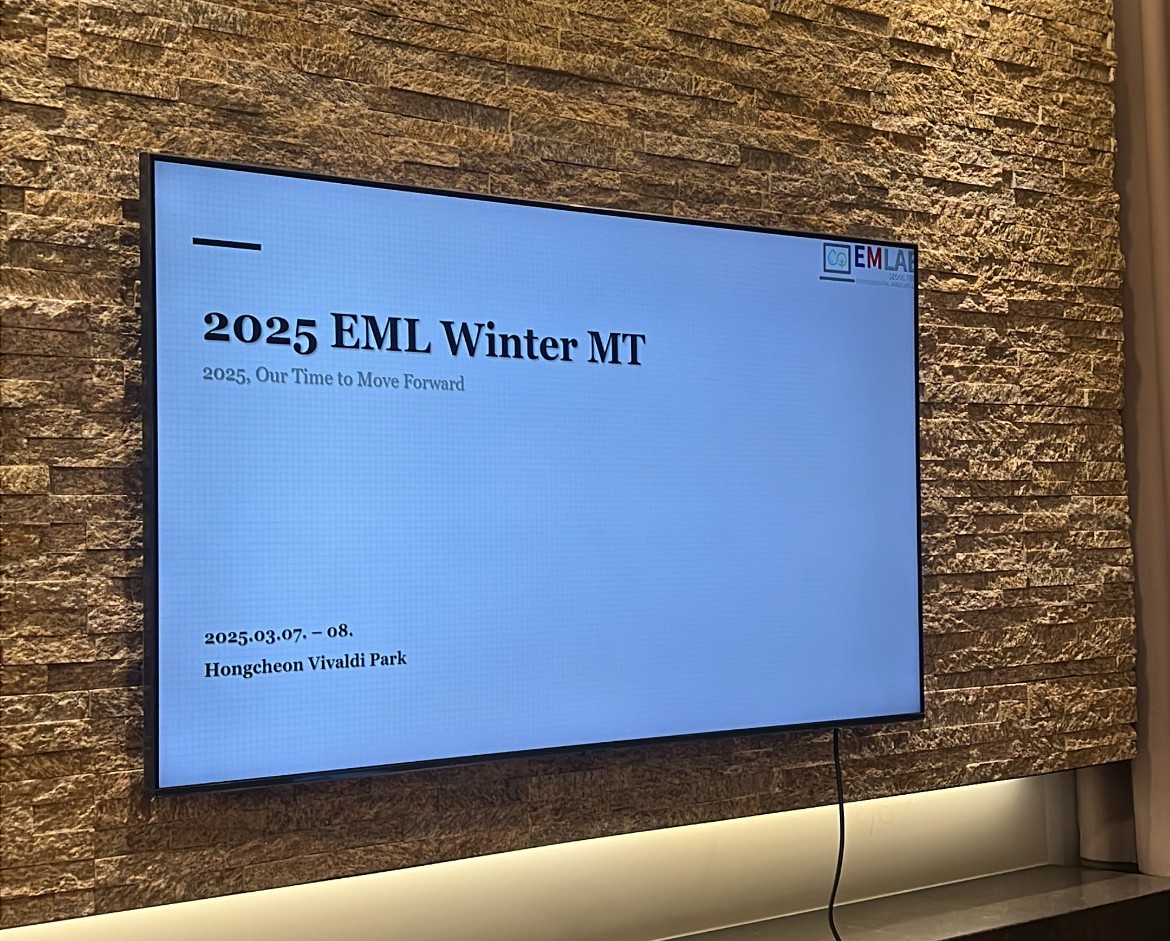
The lab held a one-night, two-day winter retreat at Vivaldi Park in Hongcheon, spending meaningful time reflecting on the past year and sharing plans for the future.
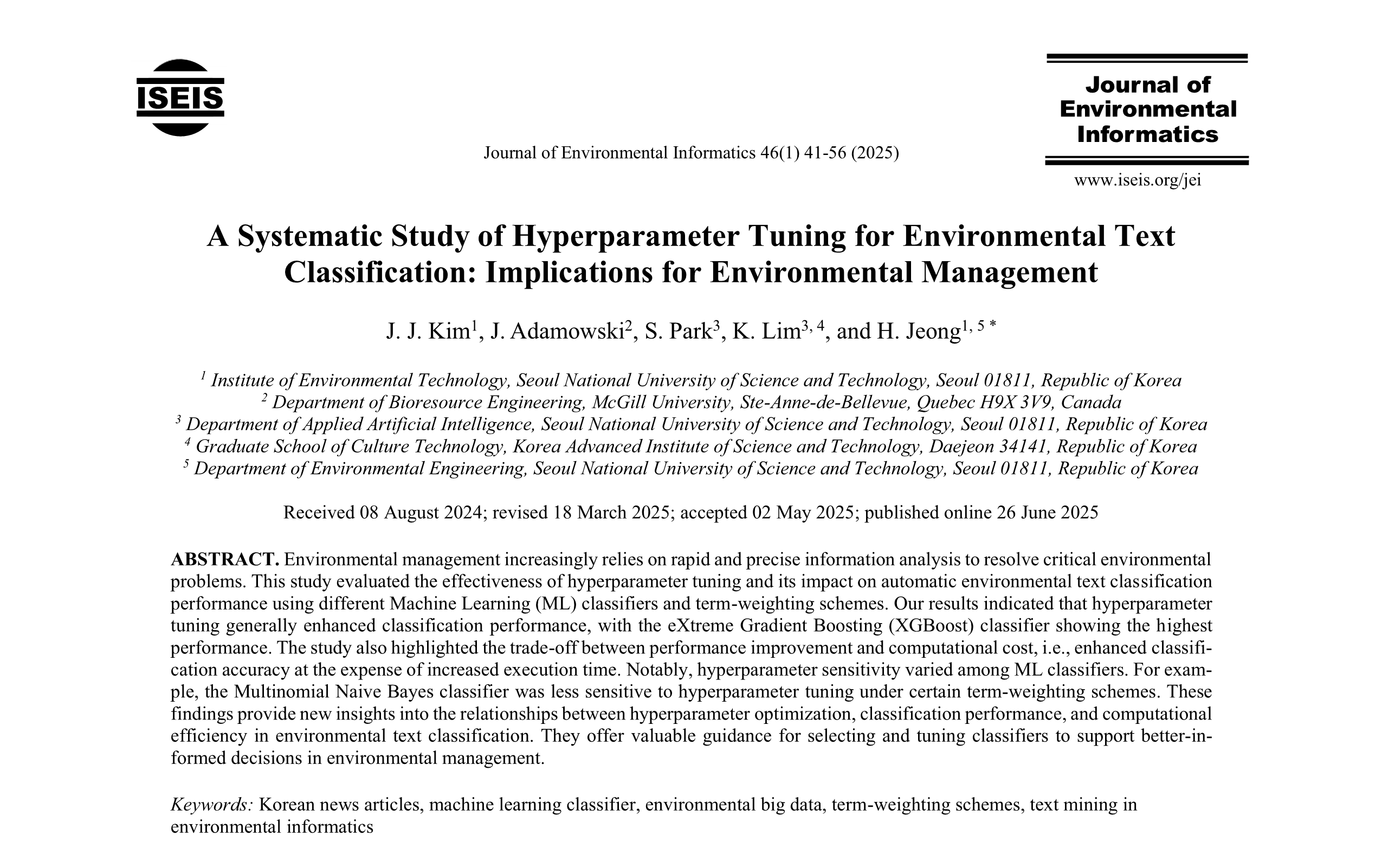
Our paper, "A Systematic Study of Hyperparameter Tuning for Environmental Text Classification: Implications for Environmental Management,” was accepted in the Journal of Environmental Informatics, a leading journal in the field of environmental information science. This study investigates the effectiveness of hyperparameter tuning in key machine-learning algorithms for processing environmental big data. Congratulations to Dr. Kim, the lead author!
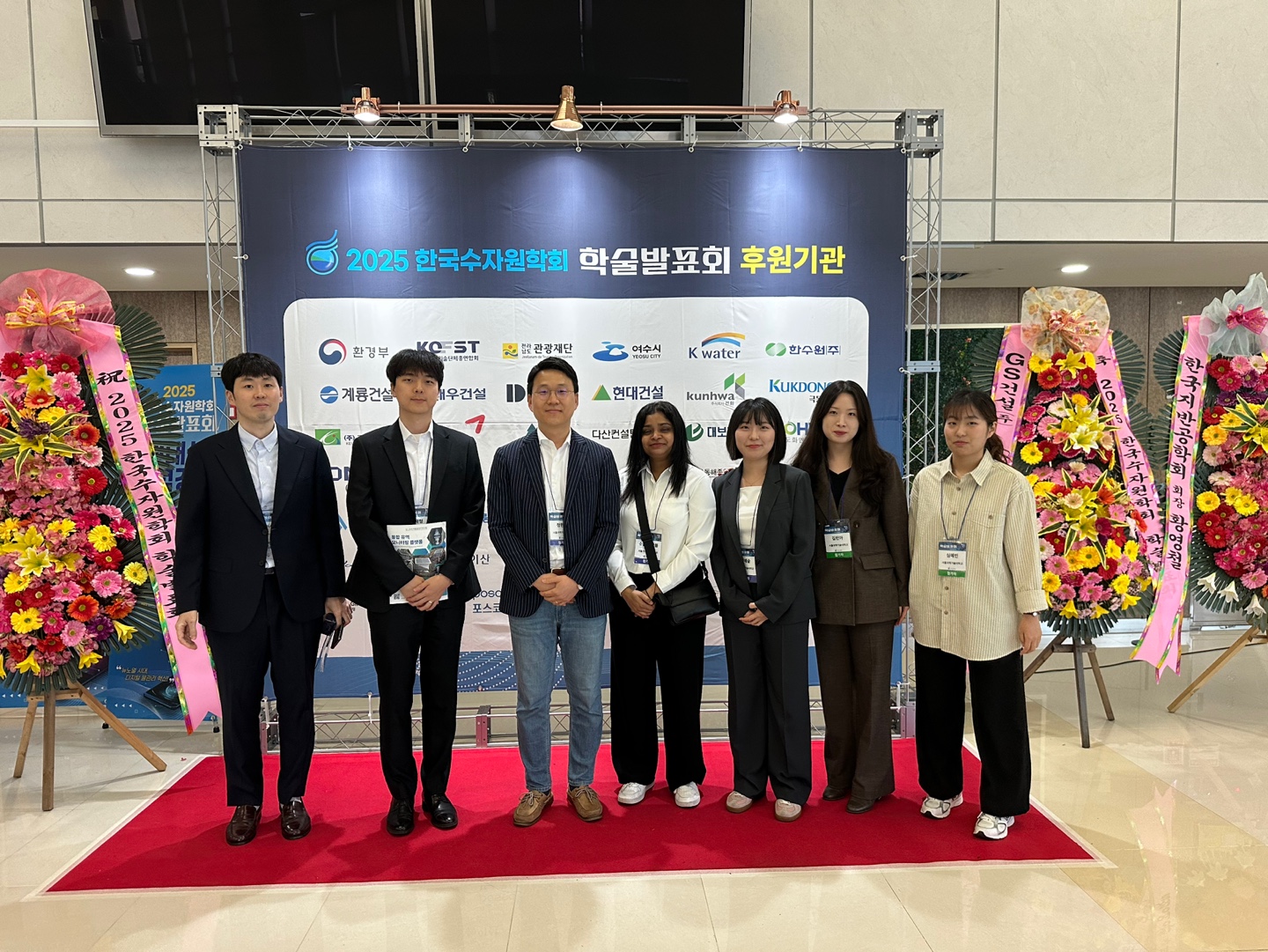
The lab attended the 2025 Spring Conference of the Korea Water Resources Association (KWRA) held in Yeosu. Juseong presented “Complementary Roles of Text Mining and Manual Coding,” Sonali presented “A Use-Inspired Sociohydrology Framework,” Minah presented “Impacts of Tile Drainage on Hydrological Systems,” Jaehyeong presented “Multi-Standard Load Duration Curves,” and Yeseul presented “Social Perception of Drought.” Jaehyeong received an Outstanding Presentation Award—congratulations!
Dahoon successfully completed his M.S. thesis defense titled “Modeling the Water Quality Improvement Effects of Best Management Practices for the Reduction of Combined Sewer Overflows.” After about three years of dedicated work, he delivered an excellent defense. Big congratulations to Dahoon for his hard-earned achievement!
The lab participated in the Expert Symposium of the Korean Society of Environmental Engineers (KSEE), held at KAIST in Daejeon from June 26–27, with Juseong and Sonali attending alongside Dr. Jeong.
Taking advantage of the advisor’s sabbatical year in the United States, the lab spent a 1-night, 2-day retreat in Gapyeong, where everyone was far too busy having fun to even remember taking photos. It turned out to be one of the most memorable retreats in our group’s history.
After serving as an undergraduate research intern at our lab and a research assistant at the Institute of Environmental Technology, Yeseul started her M.S. program. Welcome, Yeseul!
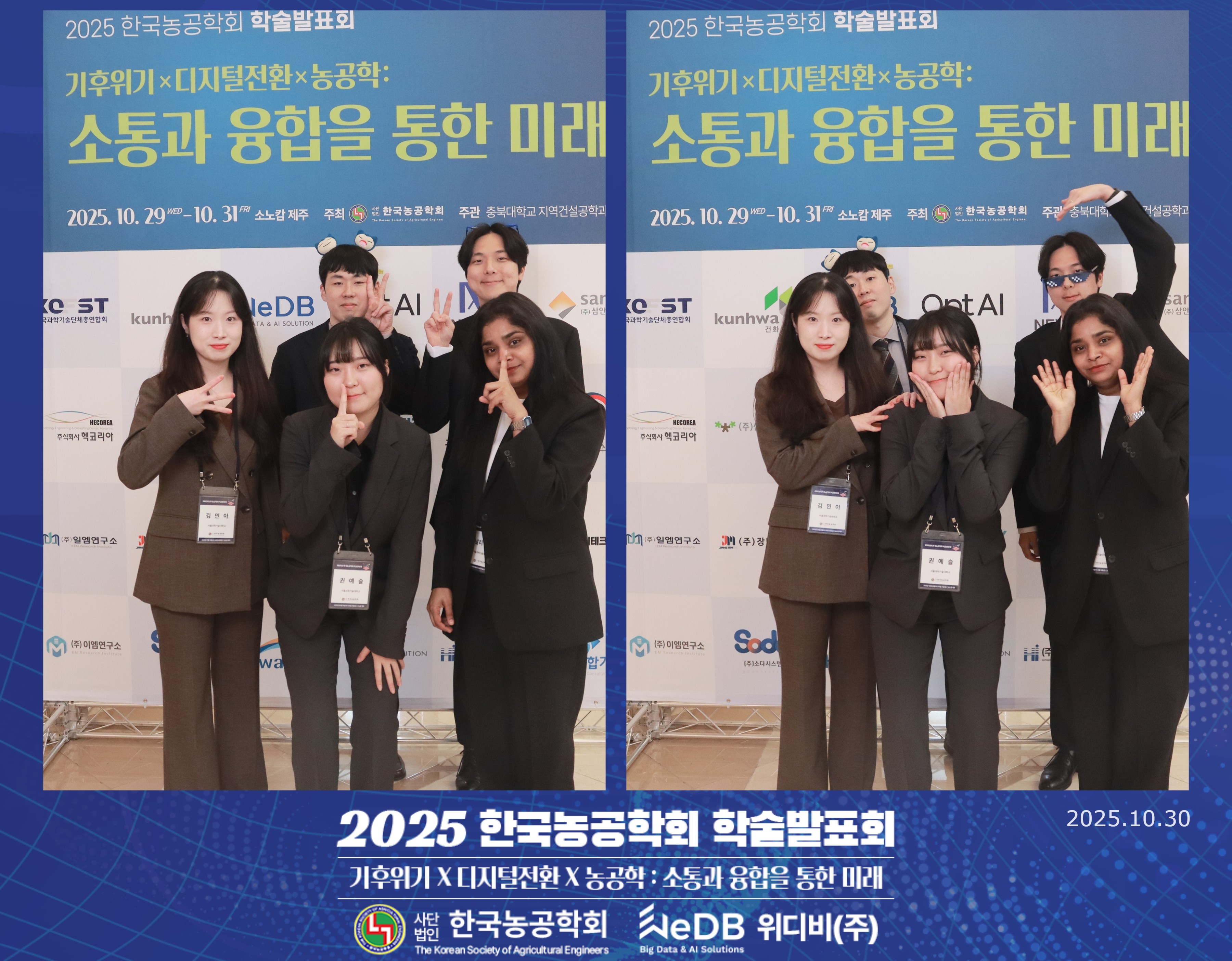
The lab attended the 2025 Fall Conference of the Korean Society of Agricultural Engineers (KSAE), held in Jeju. Juseong presented “Optimizing Farmland Subsurface Drainage Design,” Sonali presented “A Modular Sociohydrology Framework,” Minah presented “Hydrological Impacts of Nitrogen Fertilization Timing,” Jaehyeong presented “Agricultural Drainage Systems and Collective Action,” and Yeseul presented “Meteorological Drought Indices at Multiple Time Scales.” Sonali and Minah both received Outstanding Presentation Awards—congratulations!
The study previously awarded at the KWRA Spring Conference was accepted for publication in the Journal of Korea Water Resources Association, a Scopus-indexed journal. Supported by the National Institute of Environmental Research, this work proposes a new application of load duration curves for evaluating pollutant-load management performance. Congratulations to Jaehyeong on his first paper as lead author!
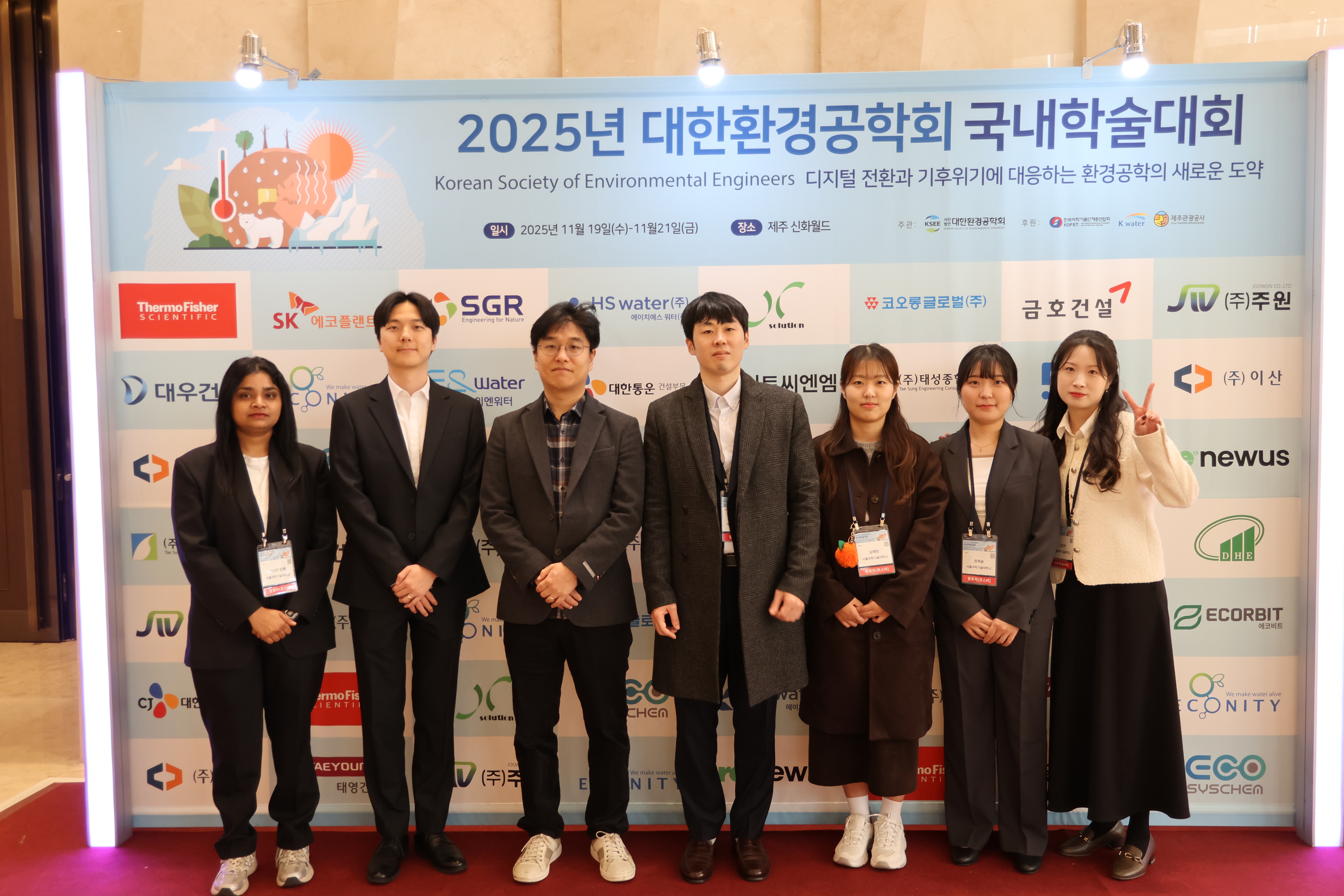
The lab attended the 2025 Korean Society of Environmental Engineers (KSEE) Fall Conference in Jeju for a 3-day program filled with presentations and, true to the spirit of an academic “symposium–conference,” even shared drinks with Prof. Oh’s group. Dr. Jungjin Kim presented “Development of a Deep Learning-Based Model for Estimating Streamflow and Pollutant Loads in Ungauged Basins,” Juseong presented “An Integrated Manual Coding–Text Mining Approach for Unstructured Big Data Analysis in the Water Environment,” Sonali presented “Strengthening Hydrology and Institution Subsystems in a General Sociohydrological Model,” Minah presented “Hydrological Impacts of Nitrogen Fertilization in a Tile-Drained Watershed under Climate Change,” Jaehyeong presented “Exploring the Effects of Climate Change on the Interactions Between Collective Action and Agricultural Drainage Systems,” Yeseul presented “A Review of Studies Toward Developing an Integrated Water Environment Assessment Framework under Compound Events,” and Yebin presented “Threshold of Impervious Area Ratio for Urban Flooding: A Case Study of the Gangnam Area Using SWMM.” Since their advisor is on his sabbatical, the group had to take a photo without him—resulting in a wonderfully gloomy-looking team photo that somehow hides the fact that everyone was actually delighted.
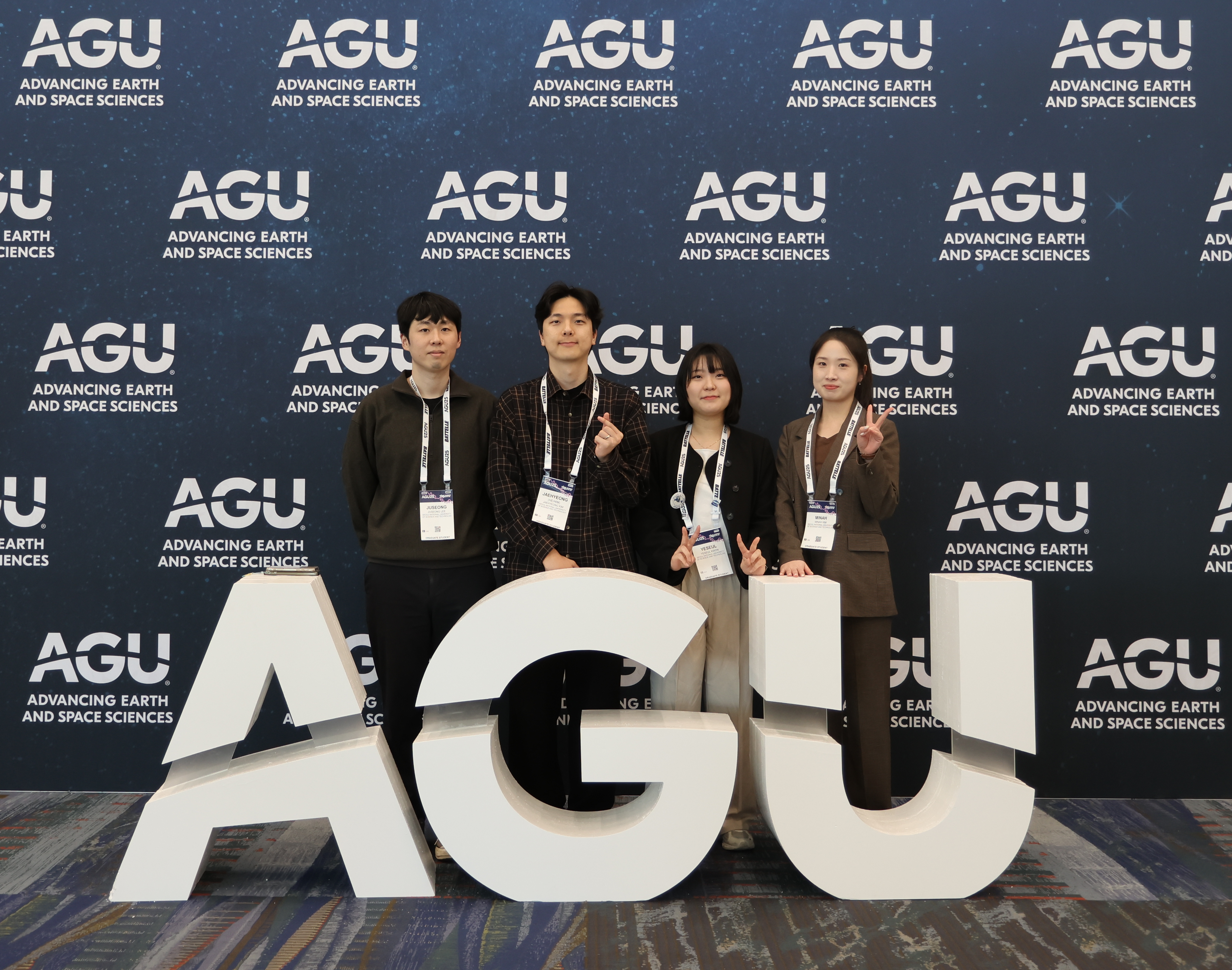
Our lab attended AGU Fall Meeting 2025, held Dec 15–19 in New Orleans, and presented five studies spanning human social sensing, sociohydrologic modeling, drought–society linkages, and hydrological response across scales under climate change: Juseong presented “Using human social sensing to understand public perception of the water environment,” Sonali presented “A Generalizable and Adaptable Sociohydrological Model: A Modular Framework for Coupled Human–Water Systems,” and Minah presented “Hydrological impacts of nitrogen fertilization in a tile-drained watershed under climate change and varying spatial scales,” Jaehyeong presented “Long-Term Socio-Hydrological Responses to Governance Design and Climate Change in Agricultural Drainage Systems,” and Yeseul presented “Analyzing the Relationship Between Meteorological Drought Indicator and Social Response of Drought.”
2024
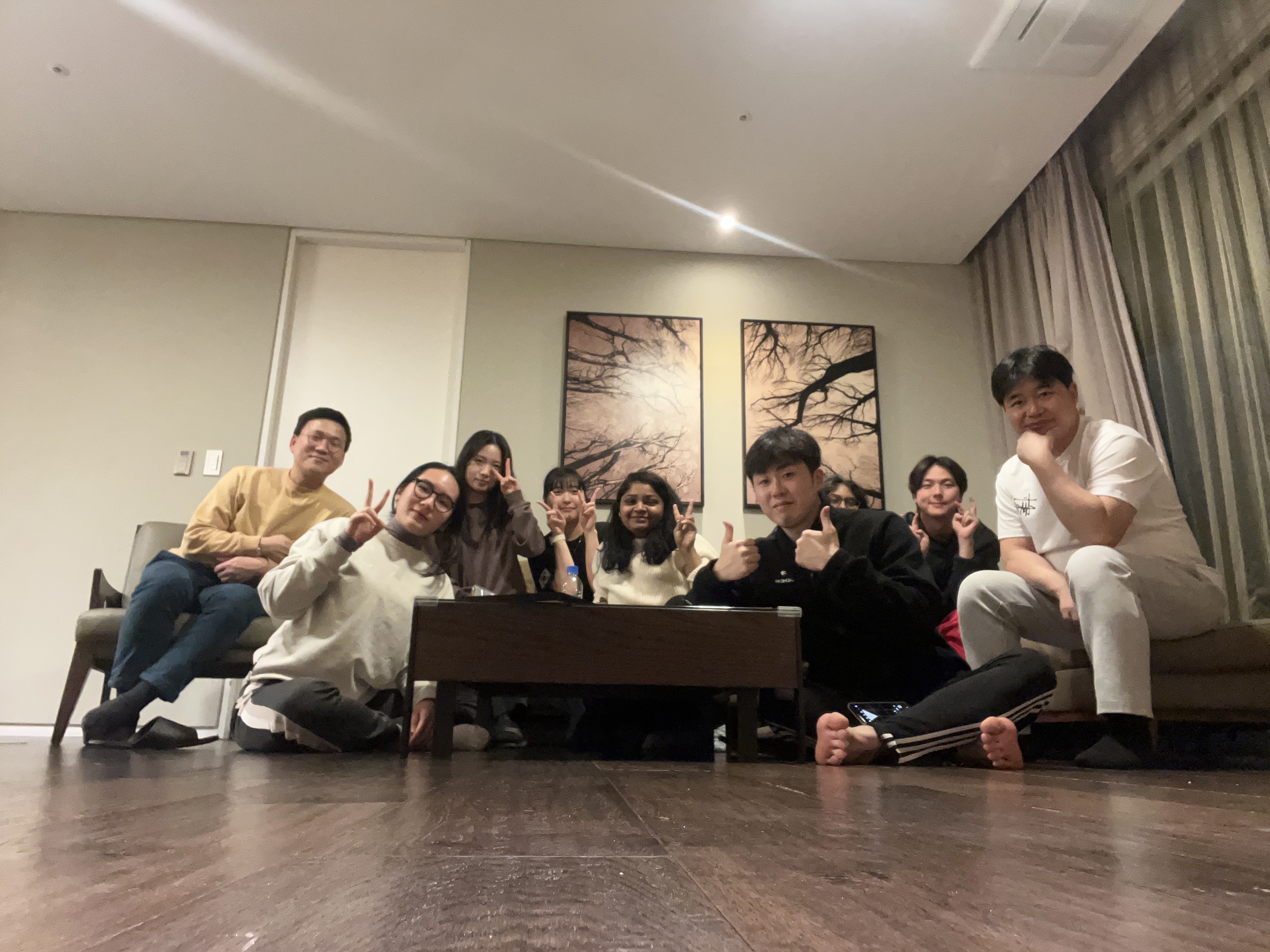
The lab held a one-night, two-day winter retreat at Vivaldi Park in Hongcheon, sharing New Year resolutions and plans for the coming year in a meaningful and refreshing atmosphere. It also marked a historic moment—the lab’s first “peaceful transfer of power,” from Kyungmin to Juseong. Our sincere appreciation goes to Kyungmin for her more than three years of devoted service, and our preemptive sympathy (and thanks) goes to Juseong, who now steps into the line of duty.
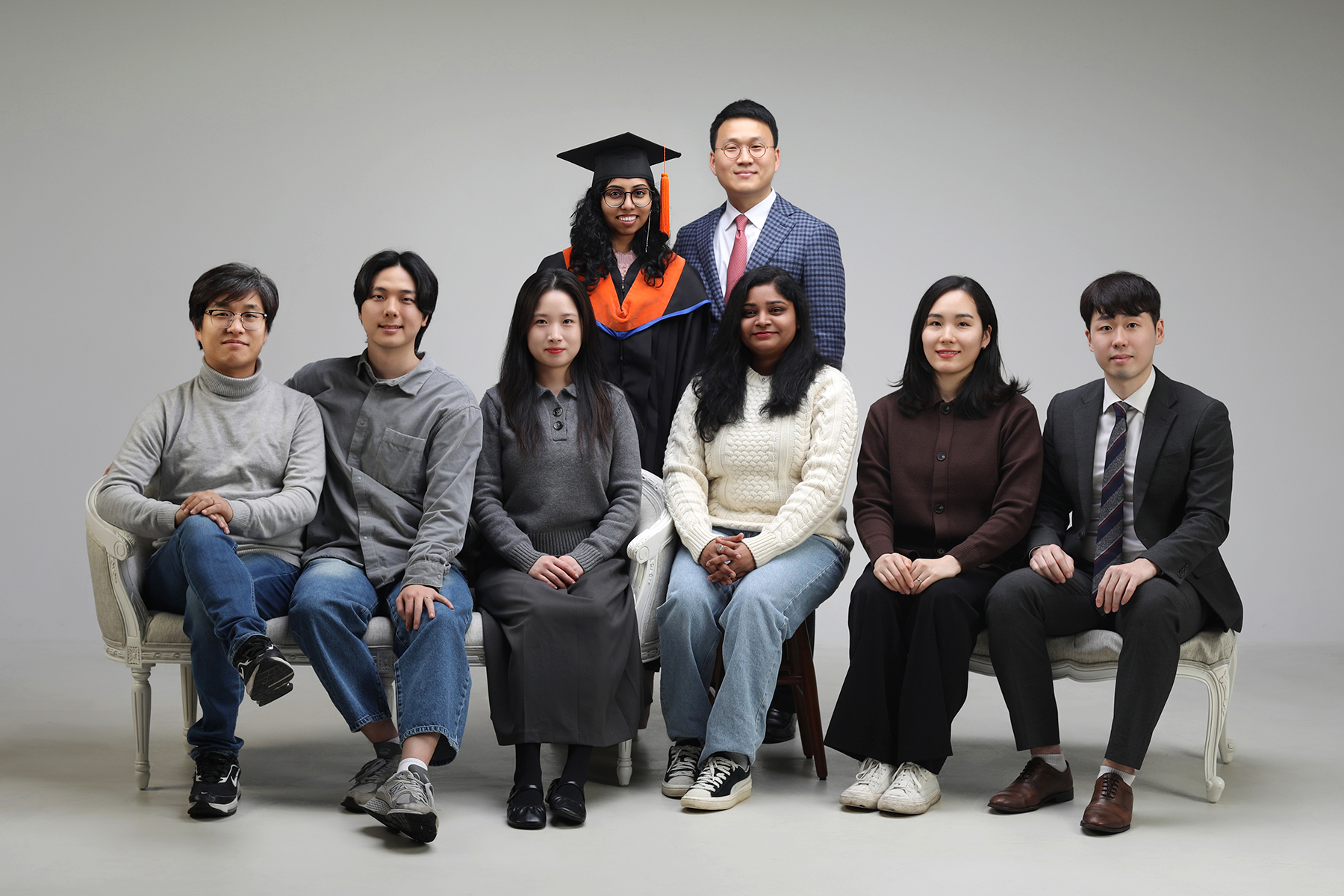
To celebrate Akshita’s M.S. graduation, the lab took a group photo together. We send our warmest encouragement as she returns to Mauritius to prepare for her next chapter of study abroad.
With the goal of pursuing graduate studies in the United States, Jaehyeong started the integrated bachelor–master program. A big welcome and congratulations on this important step forward.
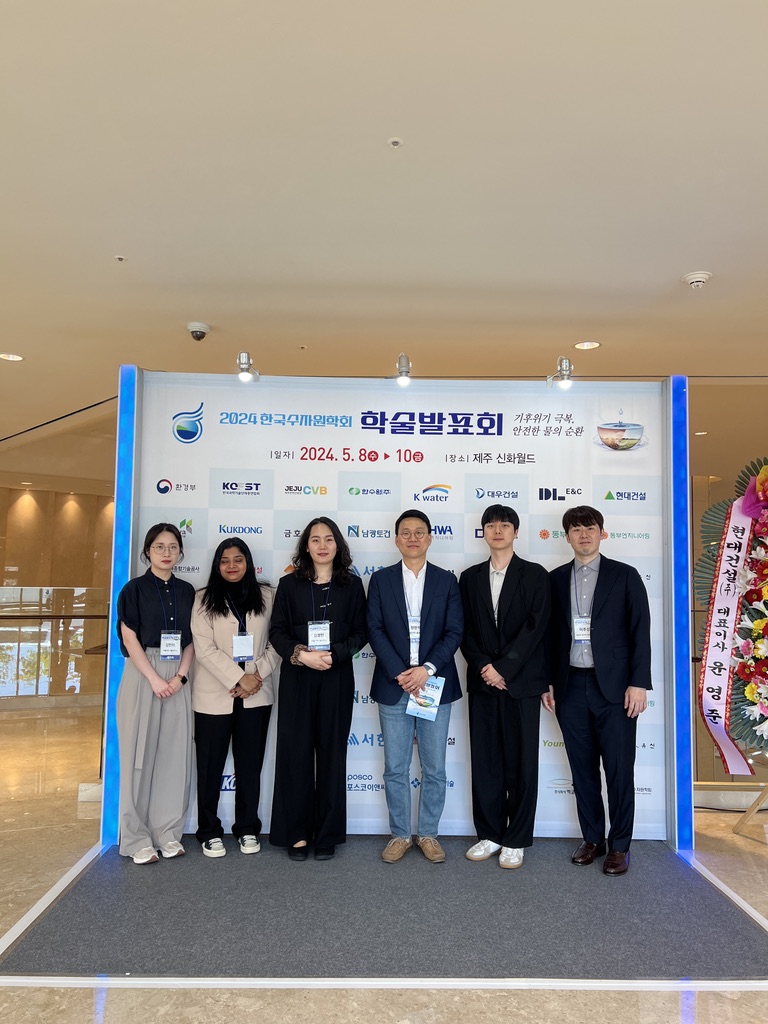
At the conference held in Jeju from May 8–10, Dr. Jungjin Kim presented “Sociohydrological Interpretation of Runoff Characteristics of Non-Point Source Pollution,” Juseong presented “Human Social Sensing for the Water Environment,” Sonali presented “Use-Inspired Sociohydrology Framework,” Minah presented “Sociohydrological Resilience,” and Jaehyeong presented “Load Duration Curves in Non-Point Source Pollution Management.”
Minah successfully defended her M.S. thesis titled “Assessing the Sociohydrological Resilience of the Gyeongan-cheon Watershed in Response to Climate and Land Use Change.” Big congratulations to Minah on completing this important milestone!
At the expert symposium of the Korean Society of Environmental Engineers held at the Suwon Convention Center (Jun 28–29), Dr. Daejung Kim presented “Global Trends and Hotspots in Microplastic Pollution Research,” Juseong presented “Development of the HSP2 Module for Microplastic Behavior Analysis,” and Sonali presented “Mapping Plastic Pollution at Scale.”
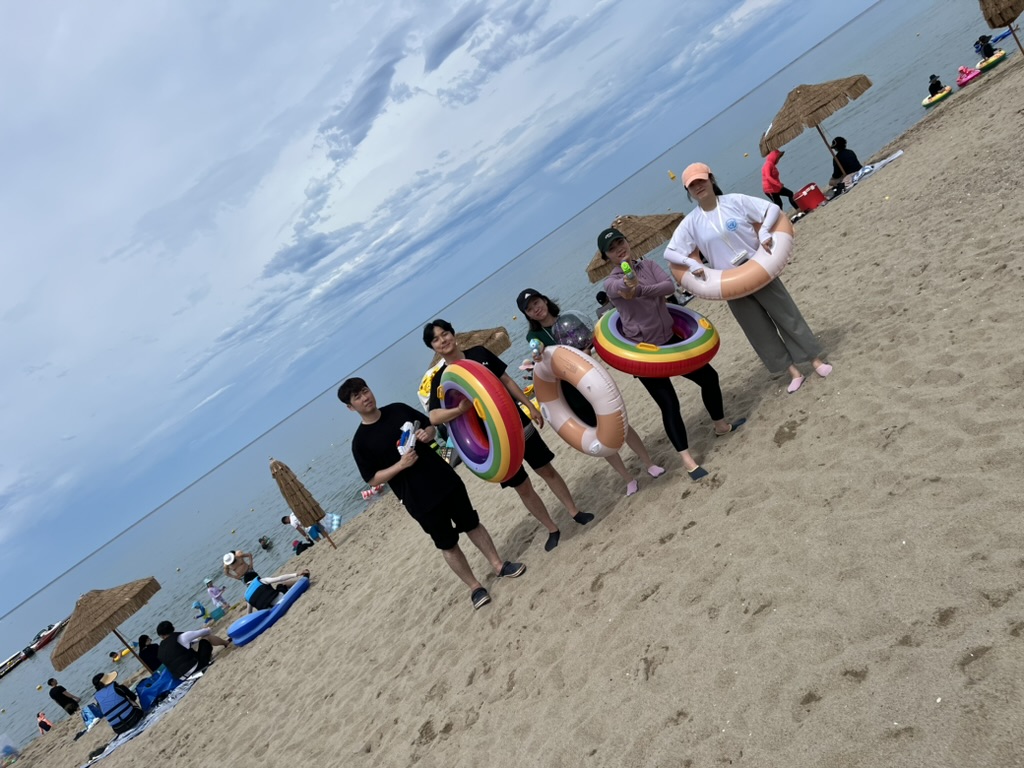
The lab enjoyed a one-night, two-day summer retreat in the popular beach town of Yangyang. Getting stung by jellyfish may have made the trip even “hotter”—but it remains one of our most memorable retreats!
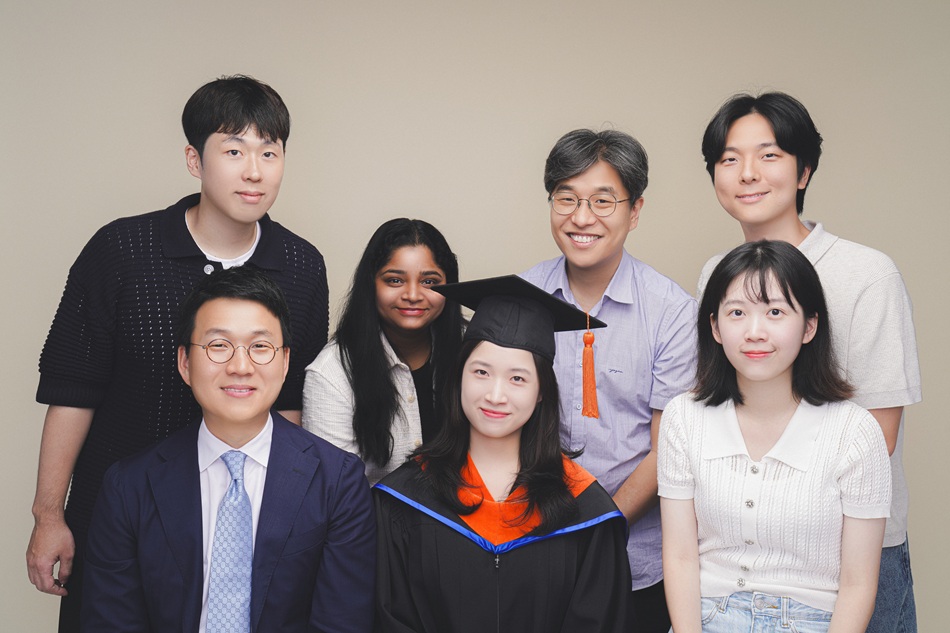
To celebrate Minah’s M.S. graduation, we took commemorative photos with lab members. We are especially grateful to Sujin, our undergraduate intern, for coming a long way to join the photo session.
Minah decided to continue her academic journey by beginning her Ph.D. program. We wish her every blessing and success as she moves into this new stage.
Through the IITP program, Juseong departed for the University of Illinois Urbana–Champaign (UIUC) to work with Professor Rabin Bhattarai. During his approximately four-month visit, he will conduct international collaborative research on improving hydrological modeling using Human Social Sensing. We wish him a productive and enriching stay—good luck!
At the conference held over three days starting October 30, Dr. Jungjin Kim presented “Interpreting Runoff Characteristics and Water Quality Variations Using Human Sensing,” Sonali presented “Applying a General Sociohydrological Model for Addressing Water Scarcity in a South Korean Agricultural Watershed,” Minah presented “Impact of Spatial Scales on Tile Drainage and Nitrate Leaching in Agricultural Watersheds,” and Jaehyeong presented “The Impact of Spatial Asymmetry and Drainage Governance Designs on the Performance of Agricultural Drainage Systems.” Sonali and Jaehyeong both received Outstanding Presentation Awards—big congratulations to both!
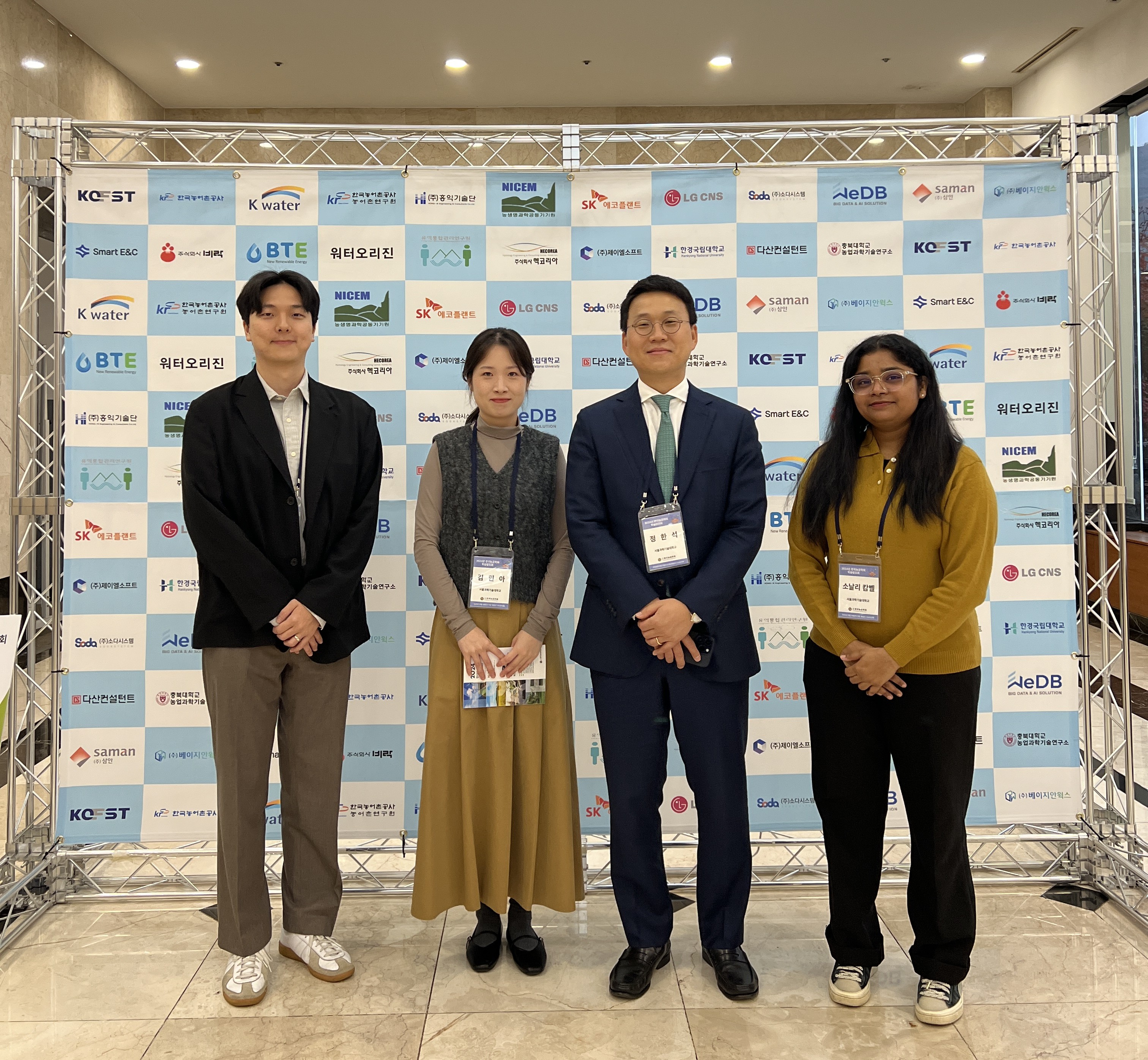
At the KSEE conference held in Yeosu over four days, Sonali presented “Development of a General Society–Hydrologic Model for Integrated Water Management,” Minah presented “Effects of Hydraulic Parameters on River Water Quality Simulations,” and Jaehyeong presented “Methodology for the Assessment of Nonpoint Source Pollution Using Load Duration Curves.”
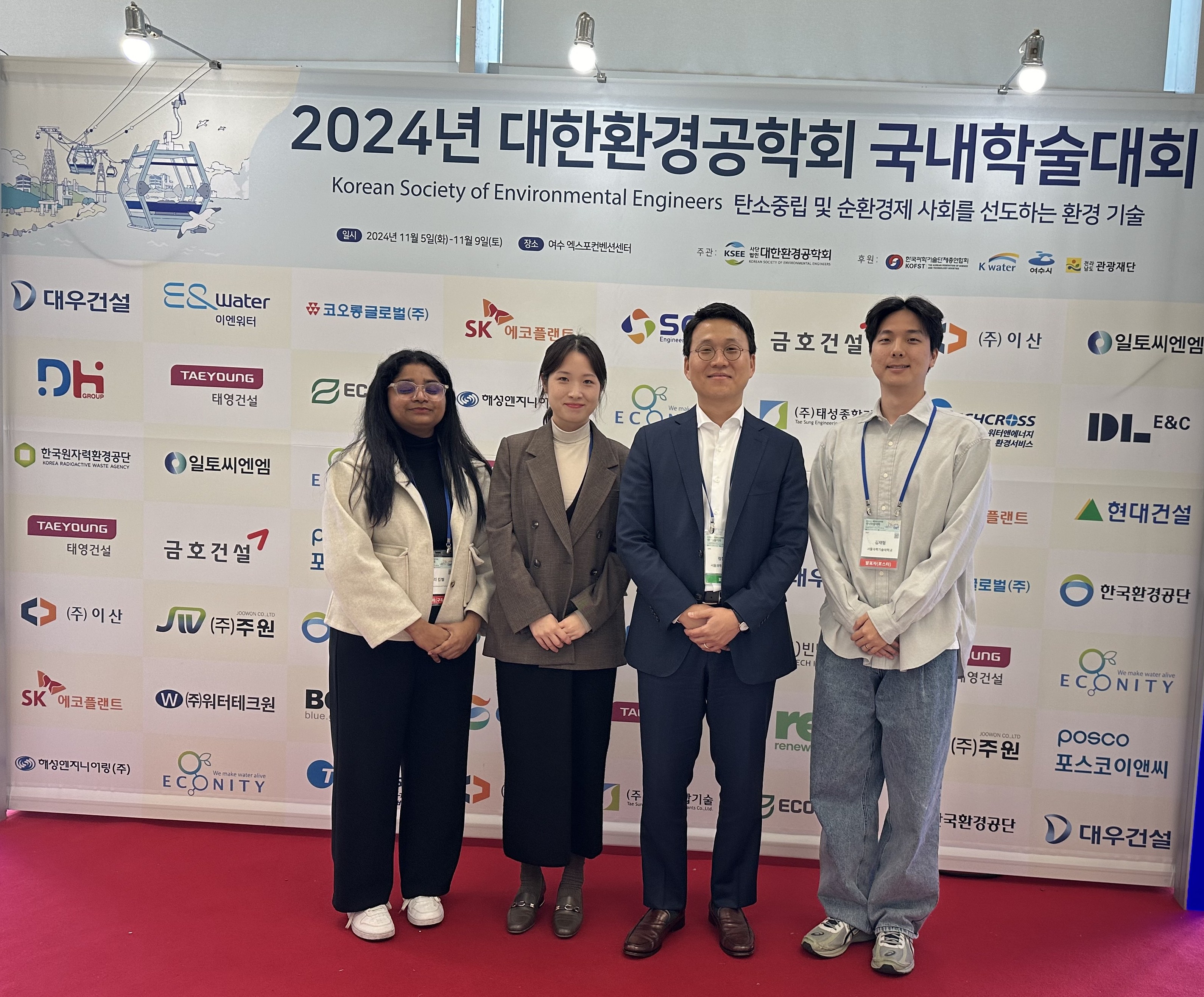
A portion of the agricultural drainage monitoring work initiated during Dr. Jeong’s postdoctoral period in the United States was published in the journal Applied Science, led by Dr. Soonho Hwang, under the title “Impact of Subsurface Drainage System Design on Nitrate Loss and Crop Production.” We extend our congratulations and gratitude to Dr. Hwang for leading this paper.
2023
The lab held its very first retreat at Vivaldi Park in Hongcheon—a one-night, two-day trip filled with unforgettable memories, including Wuseong’s enthusiastic wine pouring and a legendary hangover cured only by Soondubu yeol ramen.
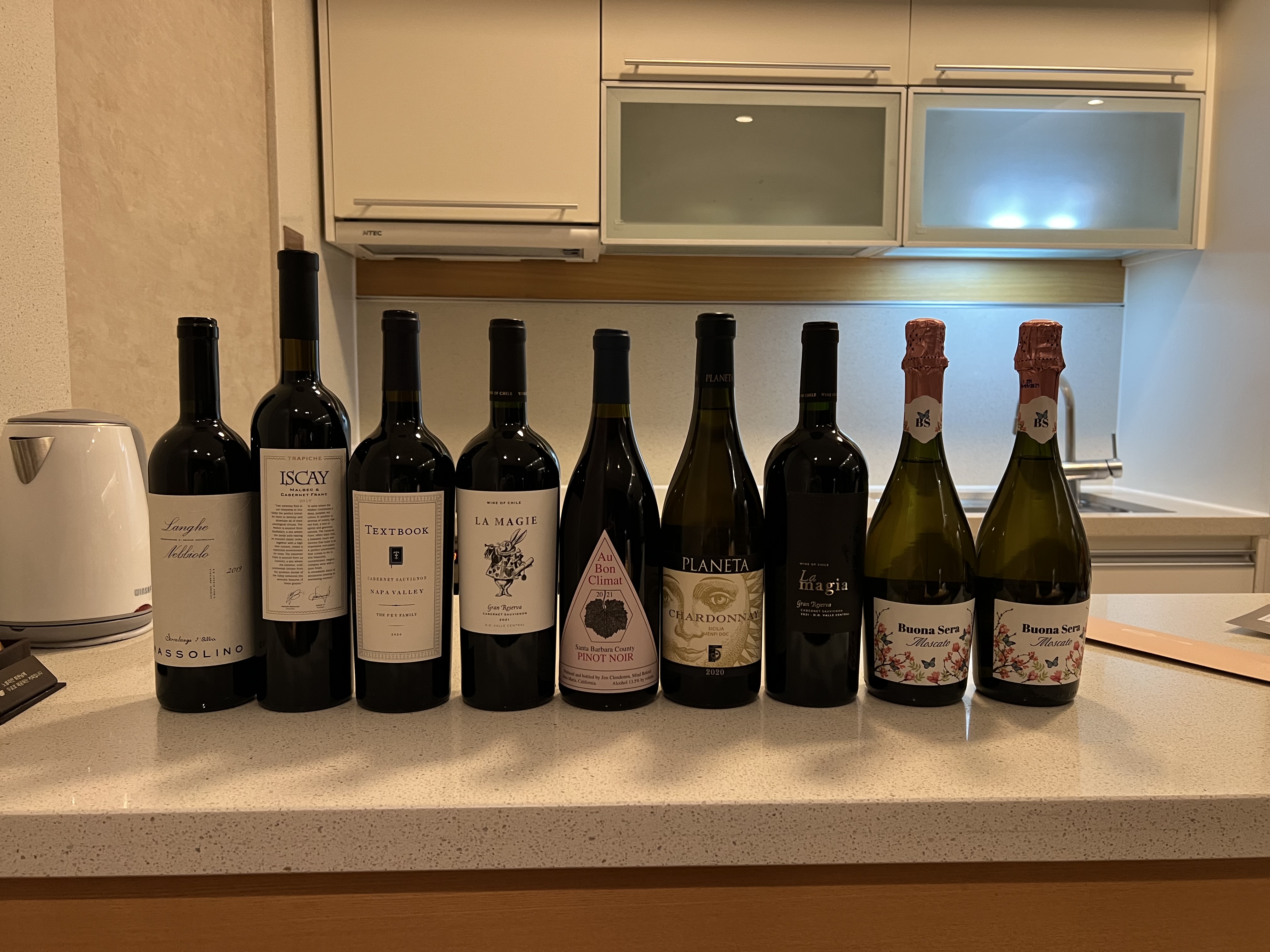
Dr. Jeong received a presidential commendation from the Korea Water Resources Association (KWRA) in recognition of his contributions to organizing the 2022 Annual Conference.
With great joy and newfound freedom, Wuseong officially departed the lab to pursue a different path. We send him warm blessings for a healthy and prosperous future.
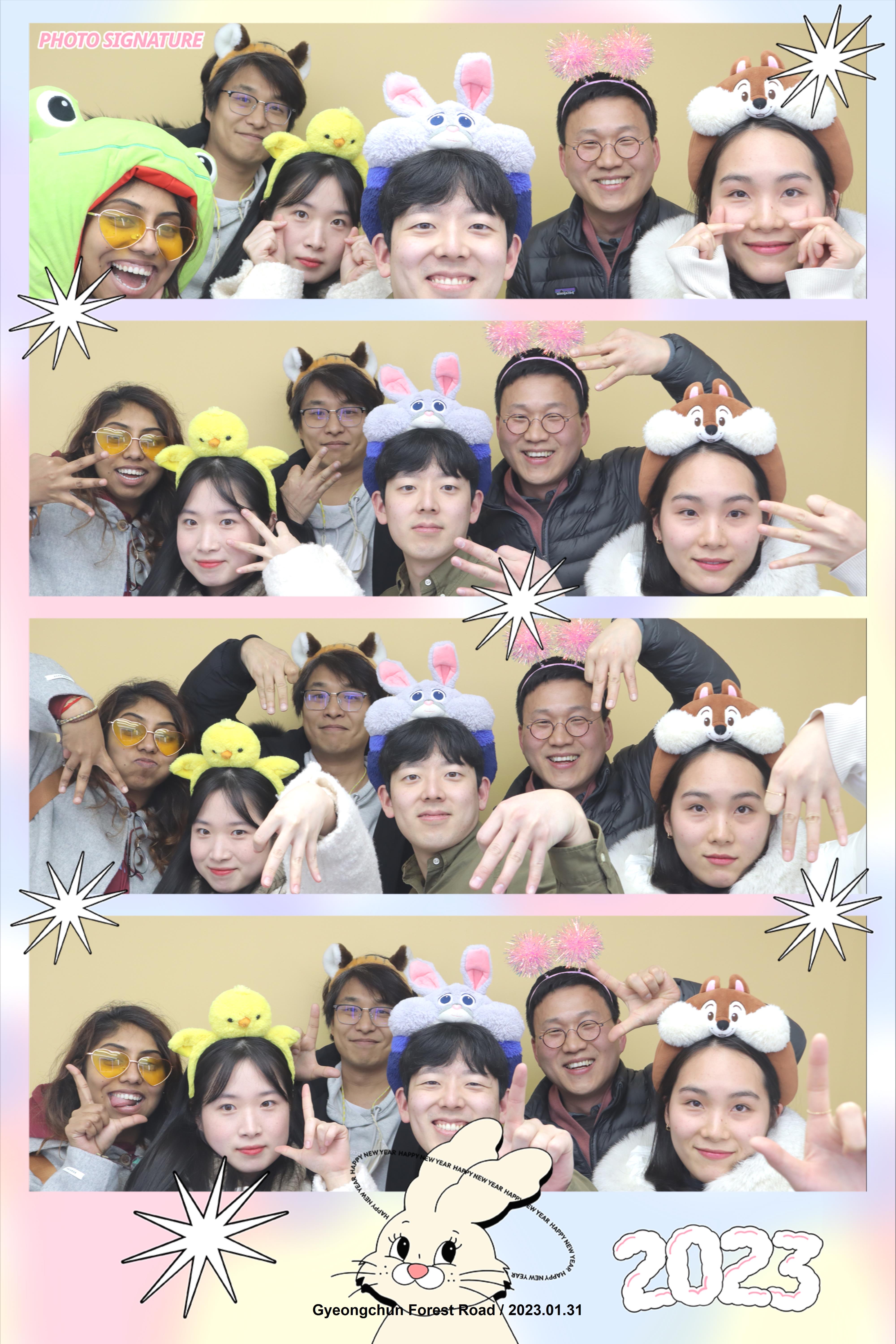
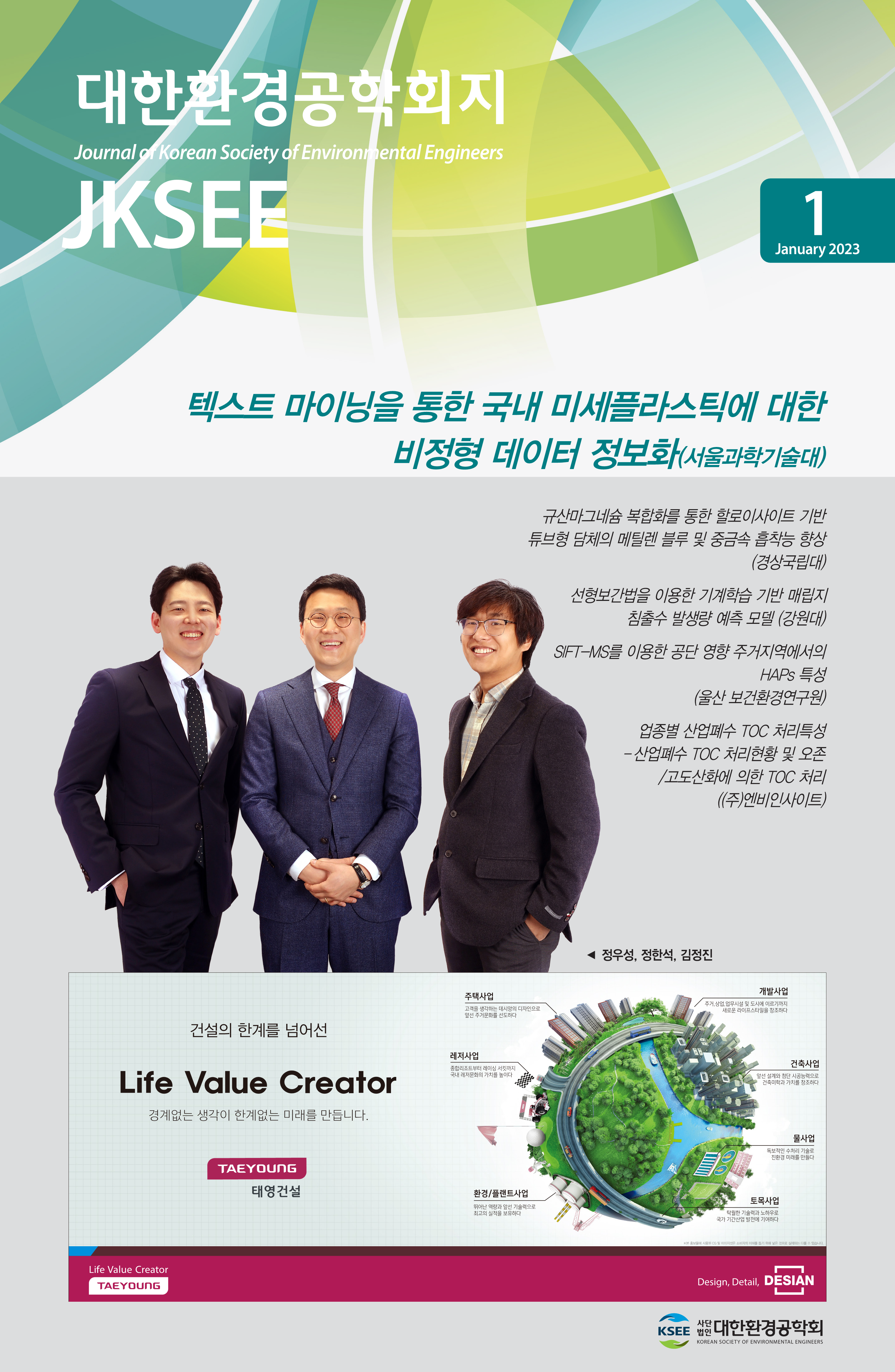
The Korean Society of Environmental Engineers (KSEE) selected Dr. Jeong as “Researcher of the Month” based on the study “Information Extraction from Unstructured Data on Microplastics through Text Mining,” led by Woosung.
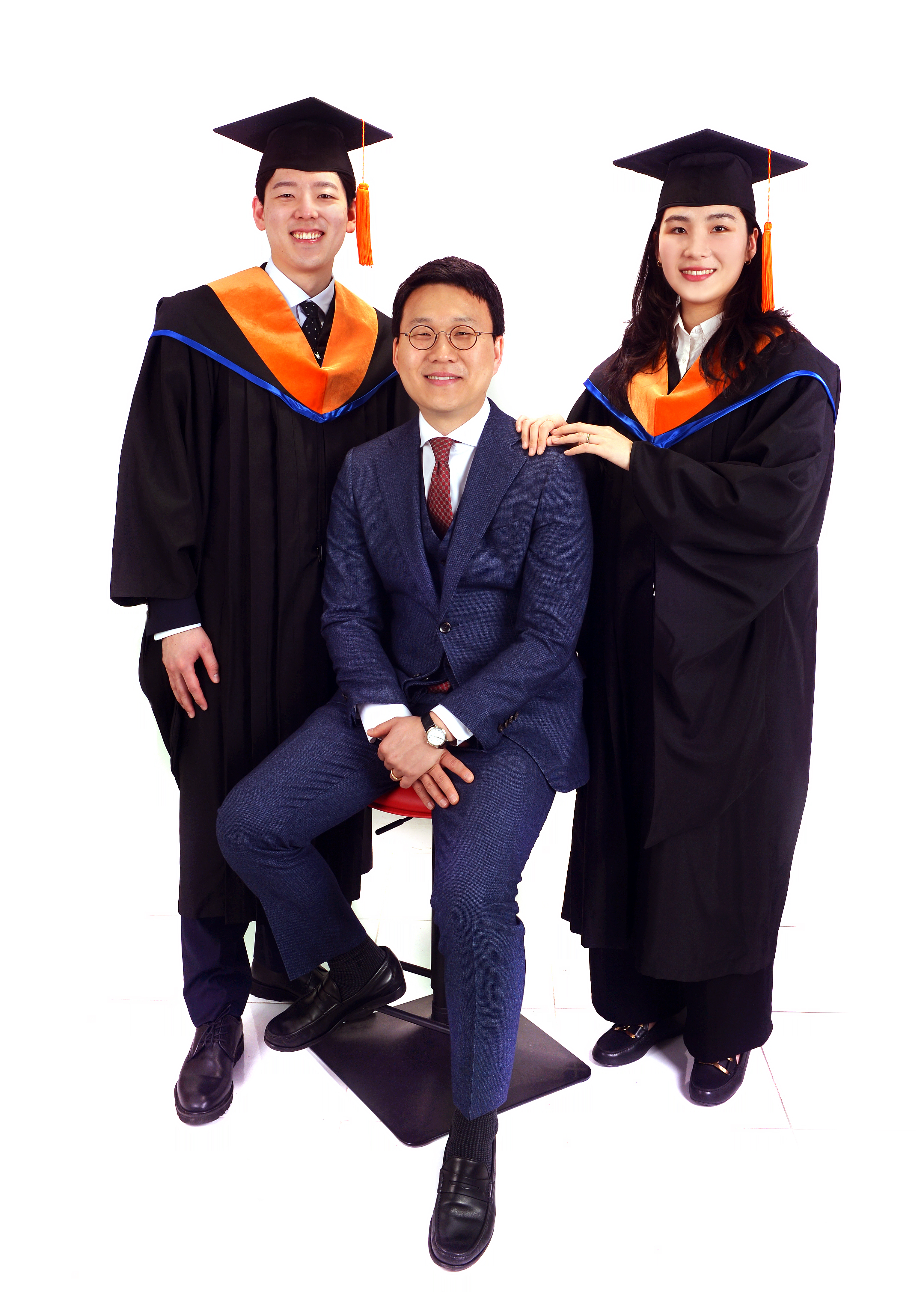
The lab celebrated the M.S. graduation of Wuseong and Kyungmin with a commemorative photo session. Congratulations to both, and warm blessings for their futures.
A collaborative study with Dr. Dubey, titled “Assessment of Hydrological Response with an Integrated Approach of Climate, Land, and Water for Sustainable Water Resources in the Khari River Basin, India,” was published in Anthropocene, a high-quality journal in Geography. We extend our gratitude and congratulations to Dr. Dubey for leading this work.
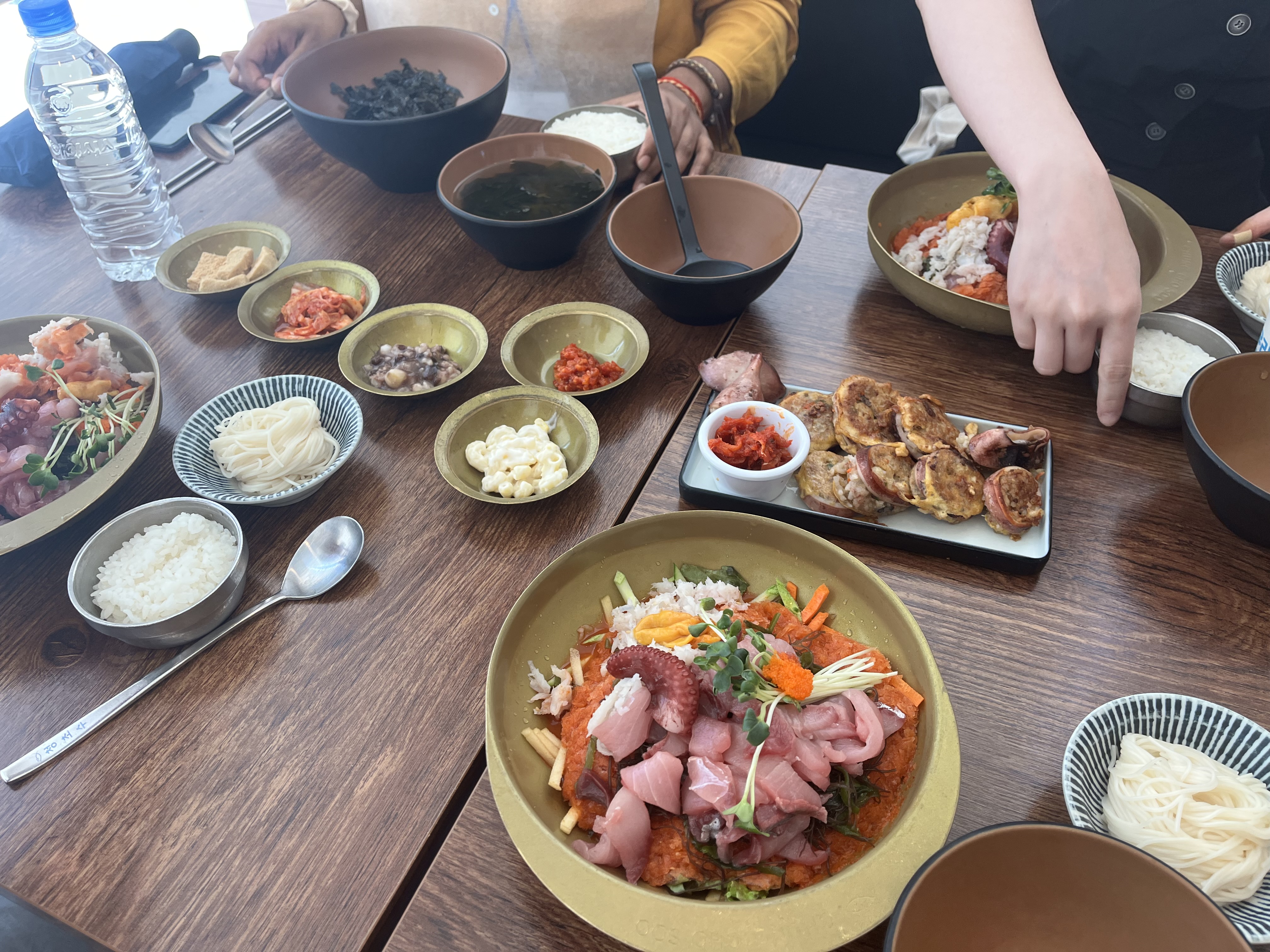
At the conference held in Goseong (May 25–26), Kyungmin presented “A Socio-Hydrologic Model to Explore the Interactions Between Humans and Agricultural Drainage Systems,” Akshita presented “A Common Sociohydrological Model Based on the Value–Belief–Norm Theory,” and Minah presented “Sociohydrological Resilience of the Gyeongan-cheon Watershed to Climate Change.” Ultimately, only fond memories of Dr. Jeong’s complaints about his glasses and Chungchosoo Mulhoe survived.
The study titled “Applicability of the WASP8 in Simulating River Microplastic Concentration” was published in the Journal of Korea Water Resources Association (Scopus-indexed). Congratulations to Kyungmin for leading this interesting work using SS and BOD as proxy variables for microplastic dynamics.
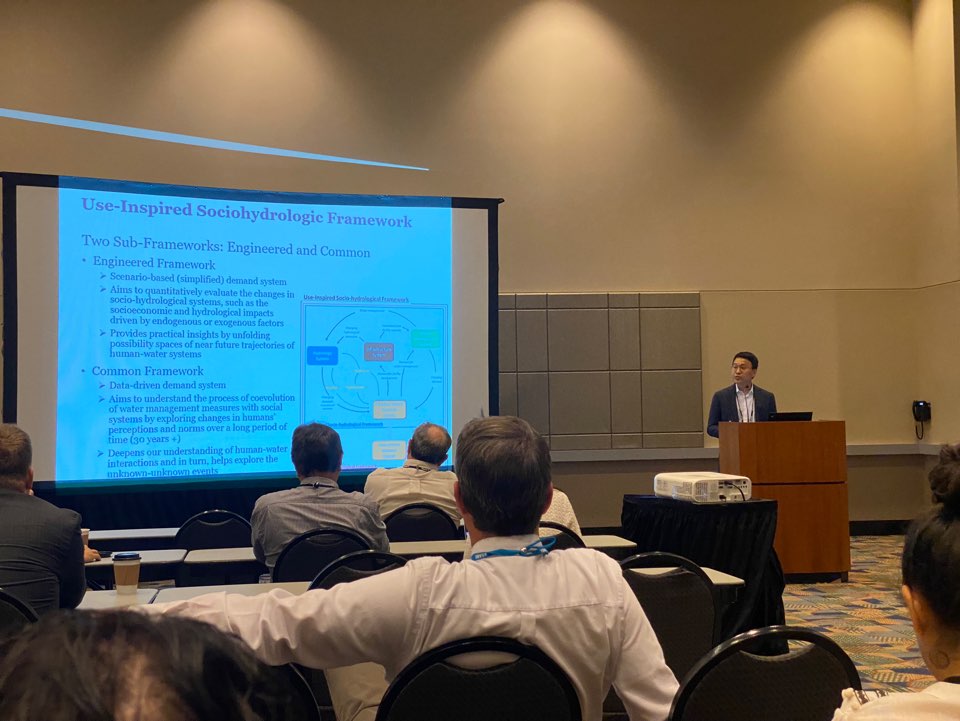
At the ASABE Annual International Meeting held in Omaha, Nebraska (Jul 8–12), Dr. Jeong presented “A Use-Inspired Sociohydrologic Framework to Help Underpin the Practices of Integrated Water Resources Management.” The audience was pleasantly surprised by the insights shared.
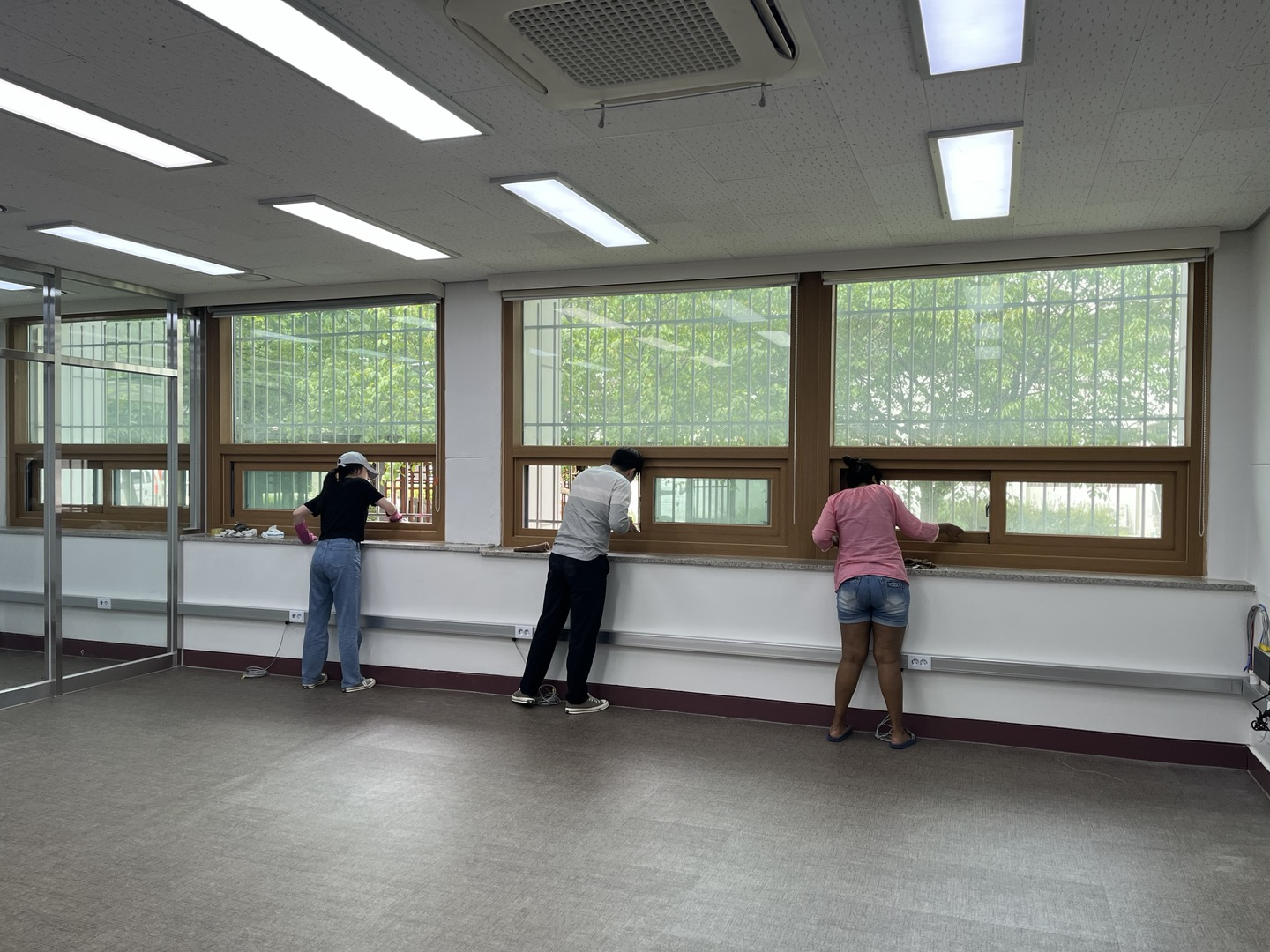
The lab officially moved to Room 120 of Chungun-Hall. Many thanks to Kyungmin, Akshita, Minah, Juseong, and Changwoo for their hard work. May this new space foster healthy research life, “Not Noise But Signal” research, and remain a welcoming home for all alumni.
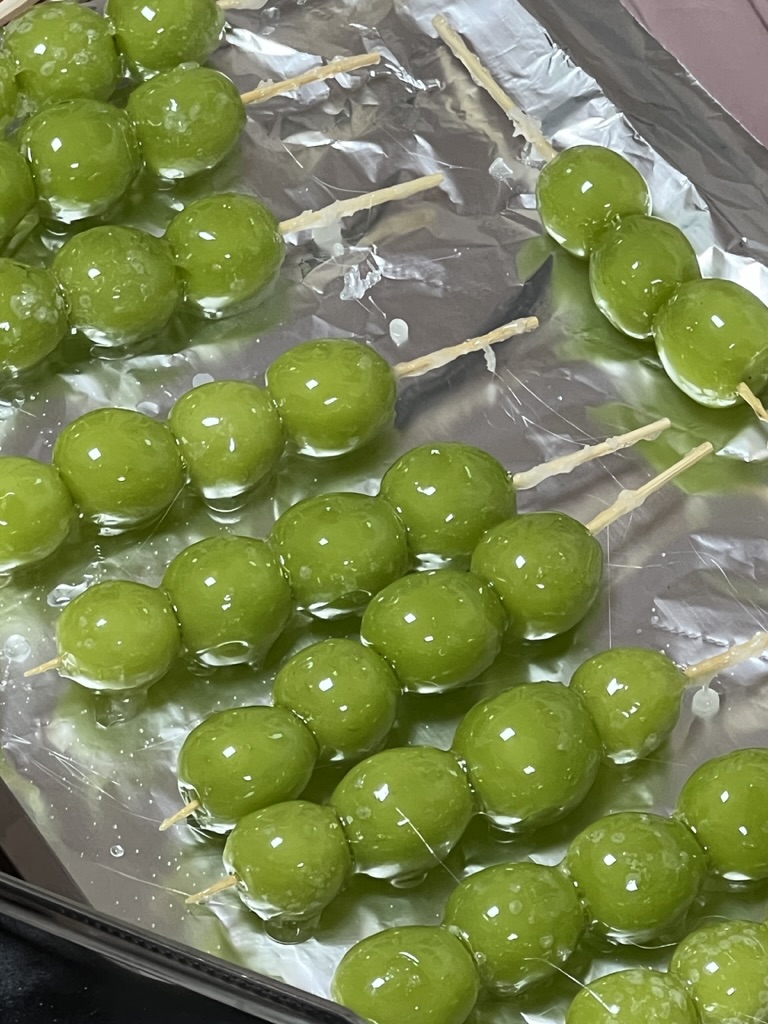
The lab held a summer retreat at the Uidong Valley, where the legendary “tangtang-hururururu” dish made an iconic appearance.
The study titled “Variability of Extreme Events in Coastal and Inland Areas of South Korea During 1961–2020” was published in Sustainability. Although time constraints limited the depth of the final manuscript, the study highlights long-term changes in temperature and extreme weather in South Korea. Congratulations and thanks to Dr. Dubey for leading this work.
Juseong, Sonali, and Dr. Daejung Kim have newly joined our group as PhD students. Juseong and Sonali are our laboratory’s first full-time doctoral students, while Dr. Kim—having previously earned a PhD in Business Administration—has joined us to pursue a second doctoral degree. Big welcome to Juseong, Sonali, and Dr. Kim! I hope this becomes a period where their time, curiosity, and commitment are truly rewarded. Wishing all three the very best as they begin their doctoral journeys.

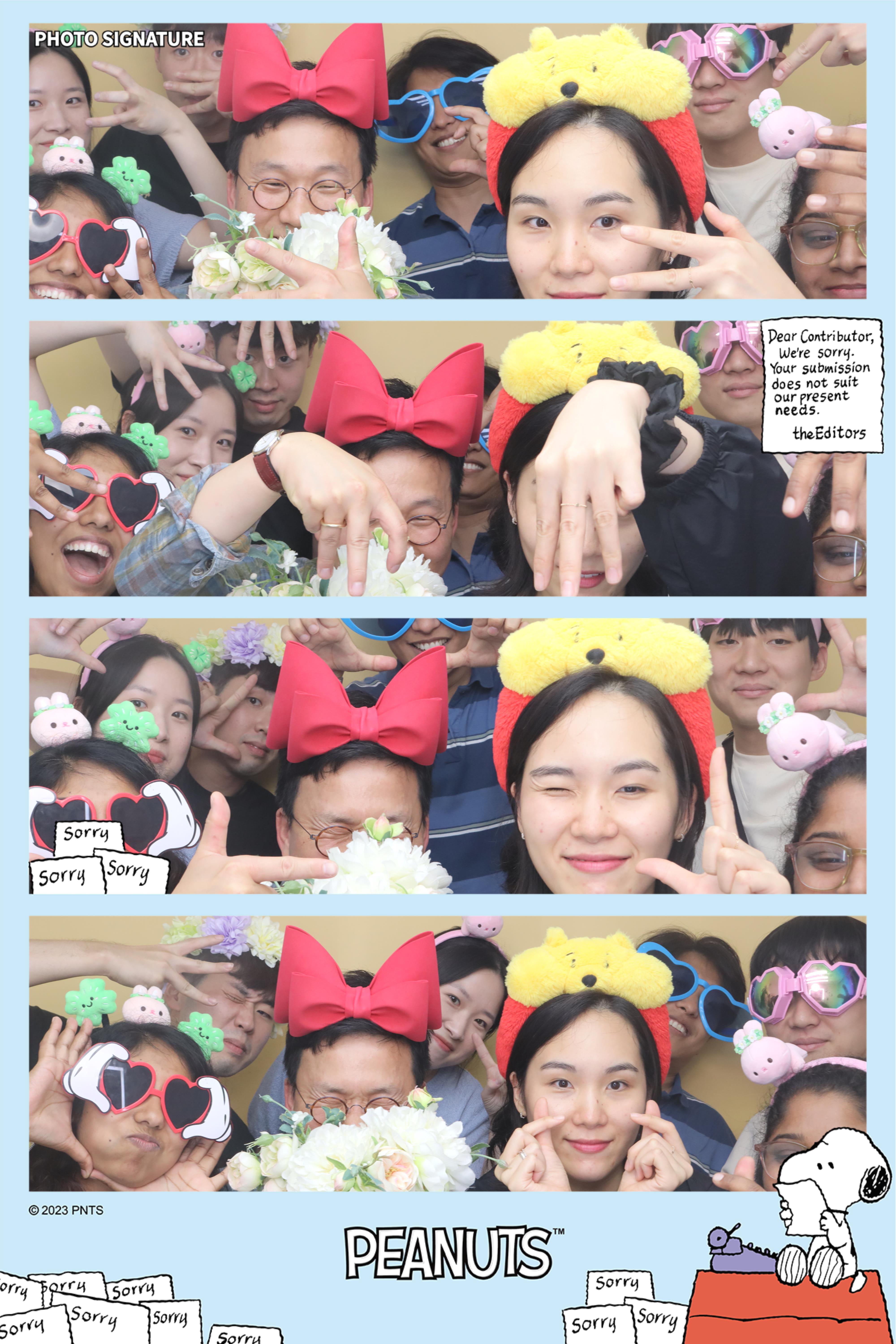
The lab held its customary semester opening party. Still carrying the warm afterglow of Dr. Jungjin Kim’s wedding, the group captured a memorable photo.
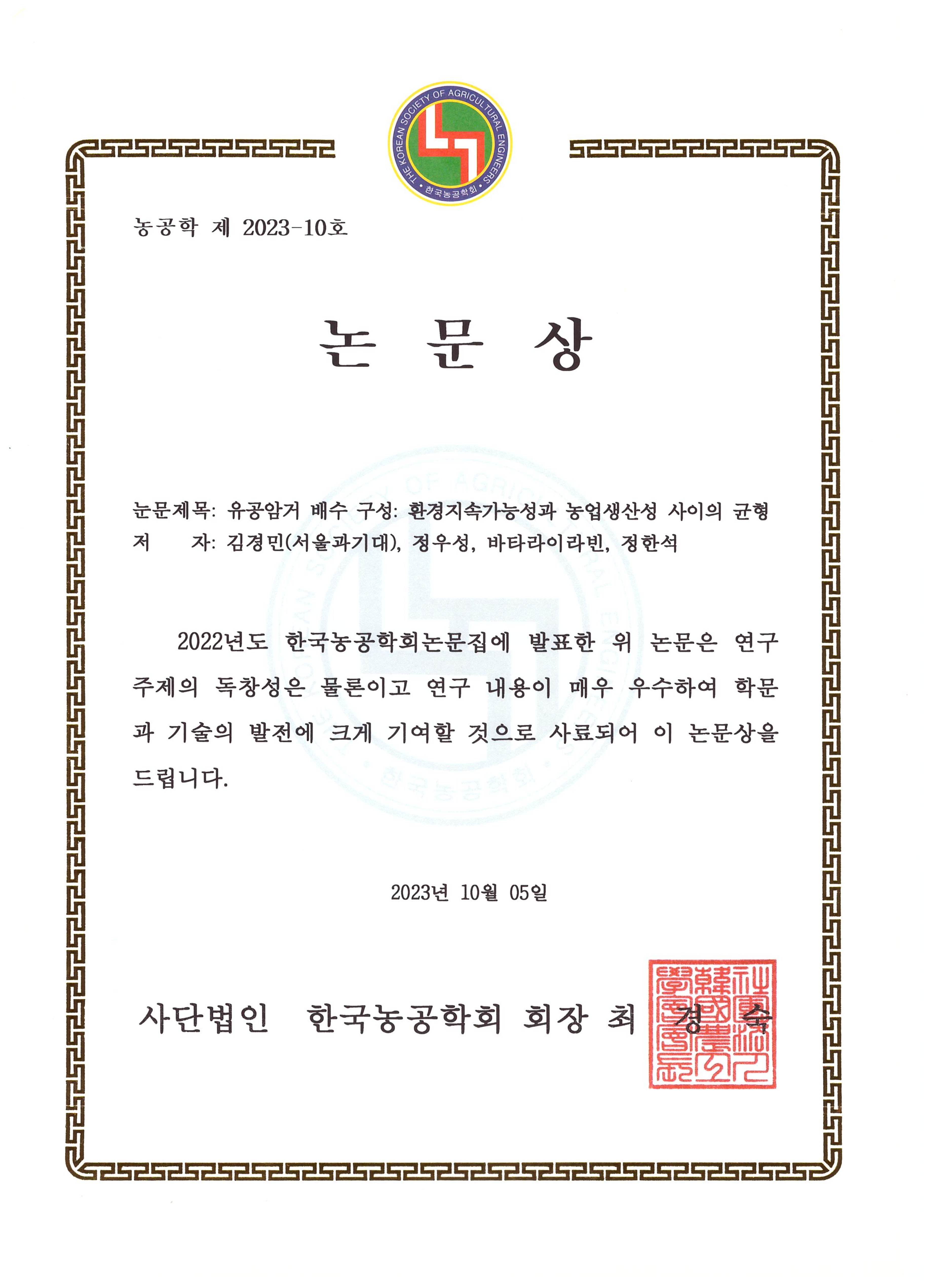
The study “Designing a Subsurface Drainage System: A Trade-Off Between Environmental Sustainability and Agricultural Productivity” led by Kyungmin received the Paper Award from the Korean Society of Agricultural Engineers (KSAE). Congratulations!
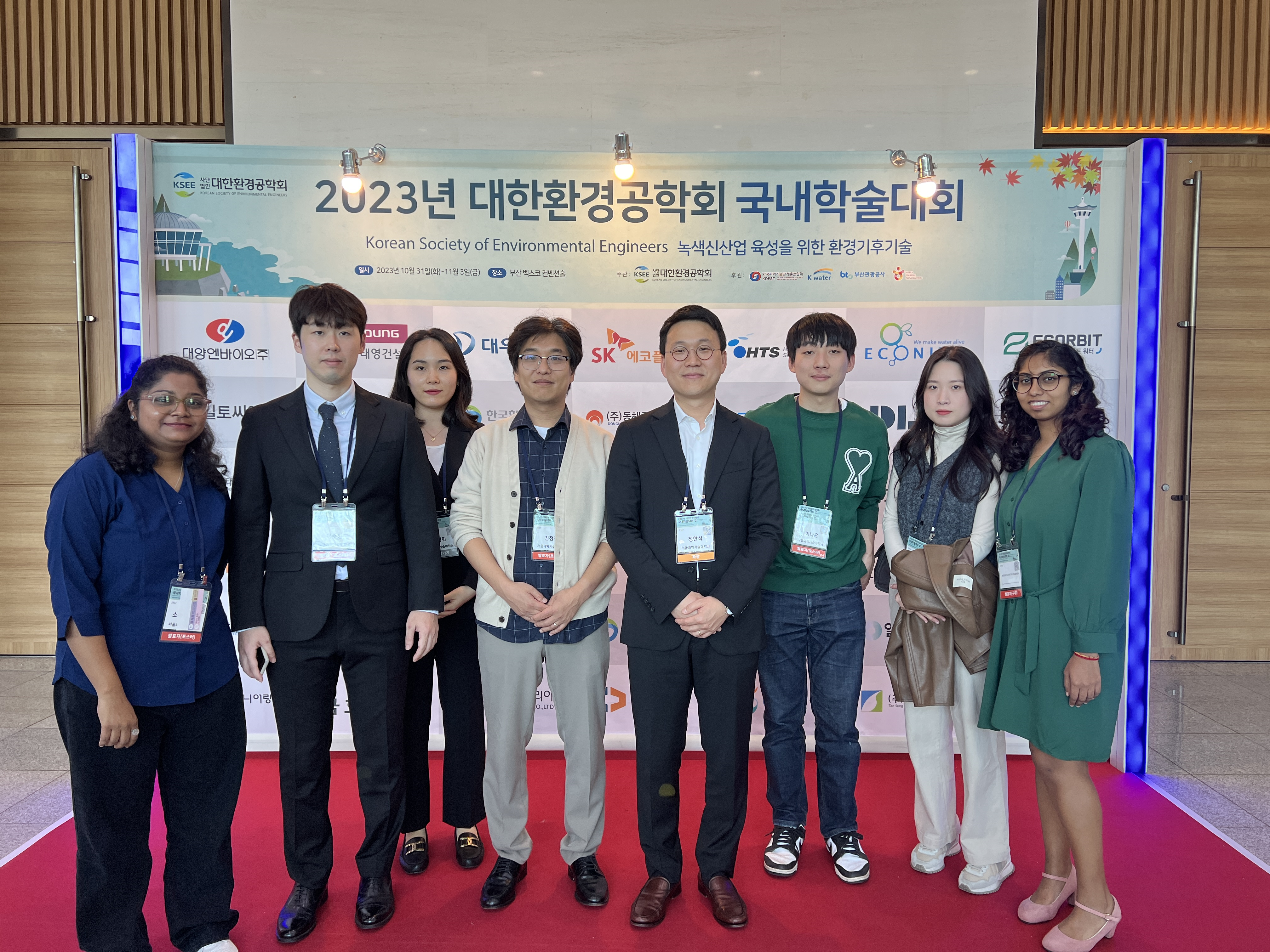
At the conference held in Busan over three nights and four days, Dr. Jungjin Kim presented “Automatic Classification Model for Environmental News Categories,” Juseong presented “Changes in Humans’ Perceptions Toward the Water Environment,” Sonali presented “Soil Erosion Assessment Using the RUSLE Model and Geospatial Techniques,” Akshita presented “A Common Sociohydrological Model Based on the ABCD Model Structure,” Minah presented “Assessing the Impacts of Novel Entities on the Watershed Environment,” and Dahoon presented “Simulation of Microplastic Transport in Anyang Stream Using the EFDC Model.”
The review study “Hydroclimatic Impact Assessment Using the SWAT Model in India—State of the Art Review” was published in Sustainability. Despite time constraints, the study provides important insights into SWAT applications across India. Congratulations to Dr. Dubey for leading this work.
At the 2023 AGU Fall Meeting in San Francisco (Dec 11–15), Kyungmin presented “Microplastics on the Boundaries of Human and Nature,” and Akshita presented “A Common Sociohydrological Model Based on the Value–Belief–Norm Theory and the ABCD Water Balance Model.” They also had the memorable experience of dining with world-renowned scholars including Professors Murugesu Sivapalan, Yongping Wei, and Saket Pande.
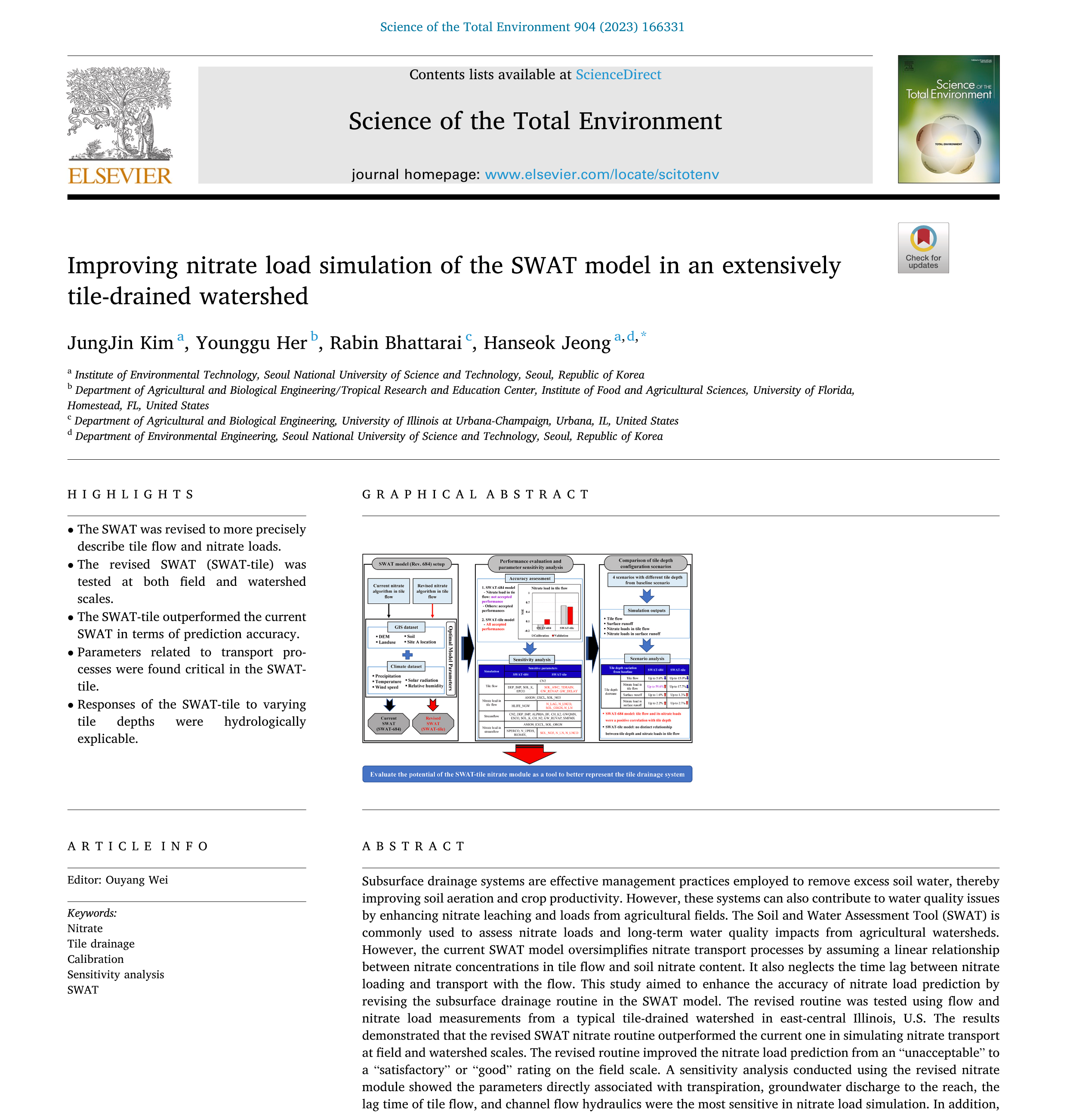
The study “Improving Nitrate Load Simulation of the SWAT Model in an Extensively Tile-Drained Watershed” was published in Science of the Total Environment. This meaningful study stemmed from the discovery that the SWAT tile drainage module contained inaccuracies. Congratulations to Dr. Jungjin Kim for leading this collaborative work with Professors Younggu Her (UF) and Rabin Bhattarai (UIUC).
2022
Wuseong and Kyungmin departed for a two-week short-term training program at Purdue University. They planned to work as short-term interns in Professor David Yu’s research group and to participate in an online seminar with Professor Rabin Bhattarai at UIUC. After the training, they also scheduled about two weeks of personal travel across the United States. We hope they would learn and experience as much as possible during this meaningful stay.
Akshita, a GKS scholar, joined our lab as an M.S. student. She plans to develop and explore research topics related to sociohydrology. Big welcome, Akshita!
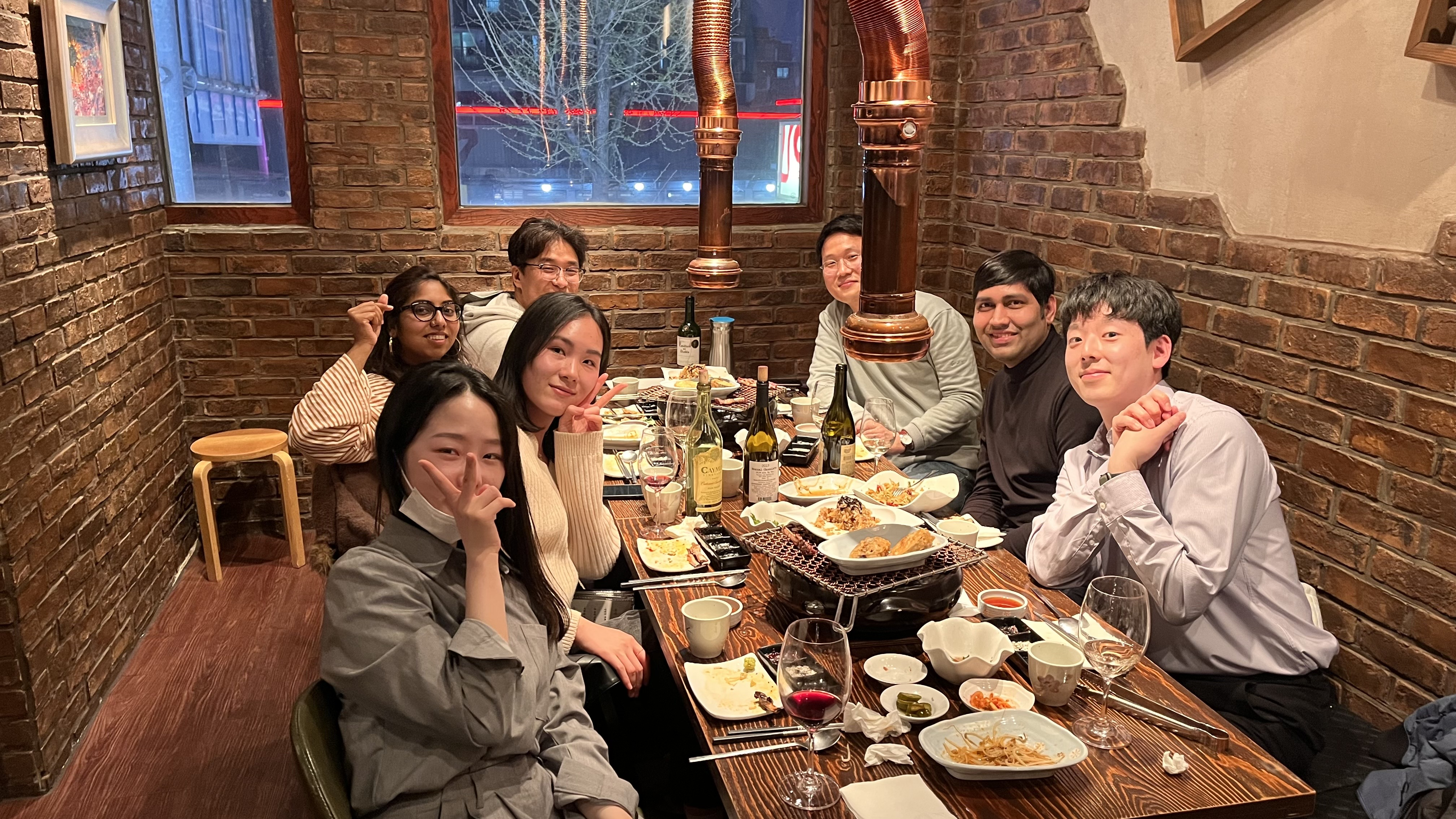
To celebrate the beginning of the new semester, the entire lab held a gathering with lamb barbecue, Caymus wine brought back from the United States by Wuseong and Kyungmin, and several wines shared by Dr. Jeong. Everyone wished for a healthy and productive semester together.
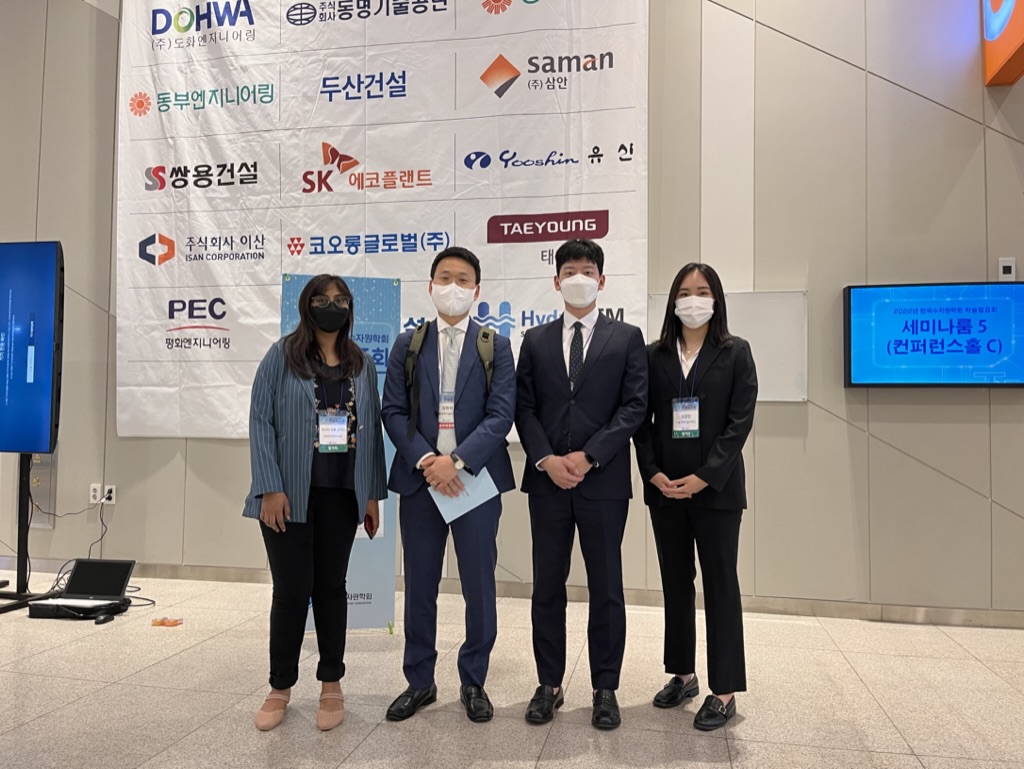
At the two-day conference held in Busan, Wuseong presented “Coevolution of Humans and the Water Environment in the Han River Basin,” Kyungmin presented “Prediction of Microplastic Concentrations in the Han River Using WASP8,” Taekyung presented “Microplastics Reduction Effects Using Dissolved Air Flotation and Brown Gas,” and Juseong presented “Transport of Microplastics in an Urban Watershed.” Both Kyungmin and Juseong received Outstanding Presentation Awards—big congratulations to both!
A collaborative international study comparing nitrogen management strategies simulated by two representative agricultural systems models was published in Agricultural Water Management, a leading journal in agronomy and water resources. The work shows that relying on a single model to interpret agricultural system responses can lead to misleading conclusions. We extend our congratulations and thanks to Shailendra, the lead author and Dr. Jeong’s former colleague at UIUC.
Paper published in the Journal of Korean Society of Agricultural Engineers titled “Designing a Subsurface Drainage System: A Trade-Off Between Environmental Sustainability and Agricultural Productivity.” This study grew out of research that Dr. Jeong conducted during his postdoctoral period in the United States. We are grateful to SeoulTech for supporting this work.
Minah and Dahoon started their M.S. programs in our lab. We warmly welcome them to academia and wish them a fruitful and inspiring graduate journey.
A collaborative study published in Agricultural Water Management showed that using cereal rye as a winter cover crop can greatly reduce nitrate pollution and drainage water in corn–soybean fields. The work highlights the potential of cover crops to enhance both environmental and agricultural outcomes. We extend our thanks and congratulations to Rishabh, the lead author and long-time collaborator from Dr. Jeong’s UIUC days.
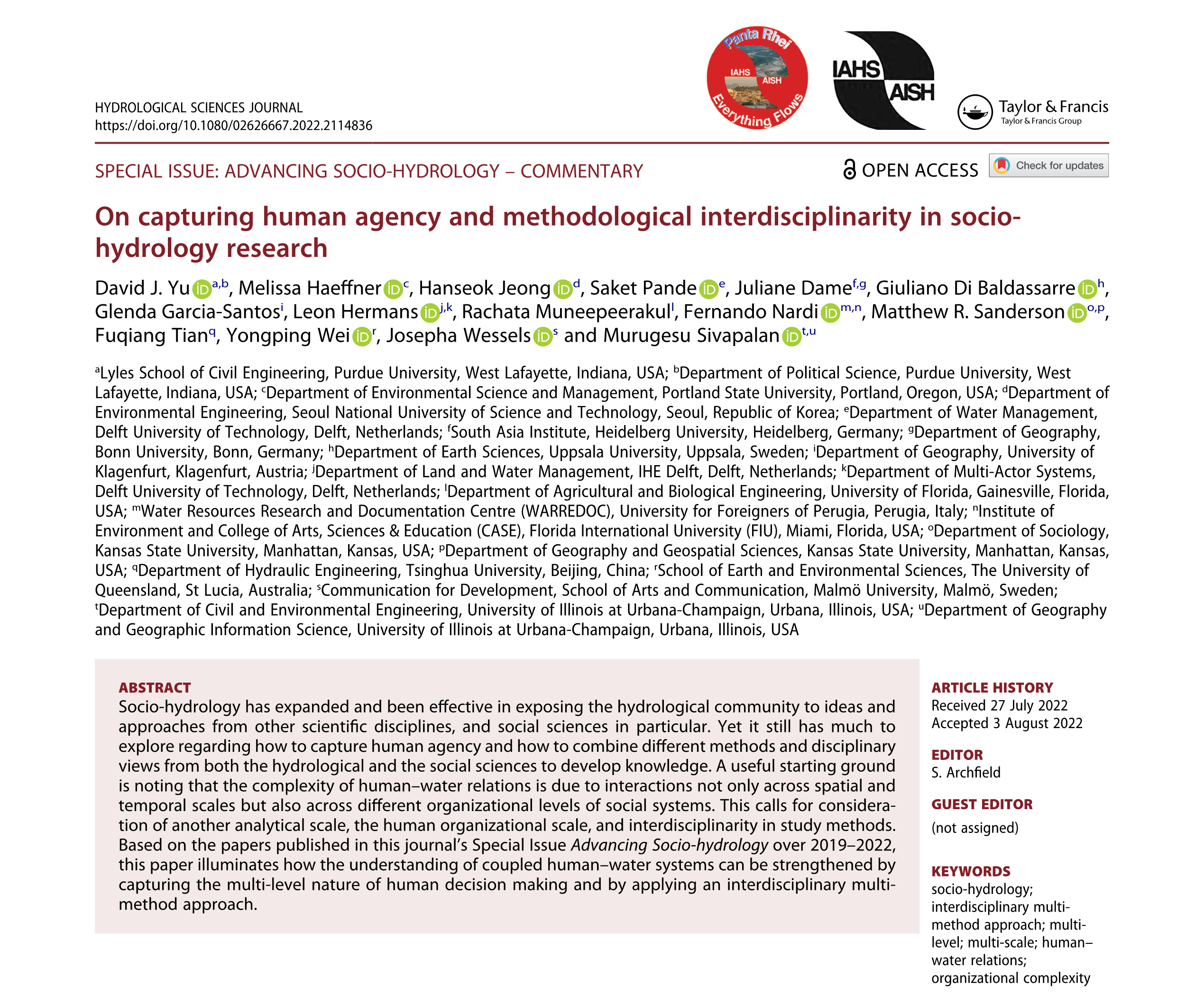
The editorial commentary article “On Capturing Human Agency and Methodological Interdisciplinarity in Socio-Hydrology Research” was published in Hydrological Sciences Journal. The piece emphasizes the need to represent decision-making at multiple levels of society and to integrate hydrology with social science methods. We are deeply grateful to Professor David Yu for leading this collaboration and for the opportunity to share and refine ideas with leading scholars in sociohydrology.
At the KSAE Fall Conference held in Daegu, Dr. Jungjin Kim represented the lab and presented “Analysis of Changes in Keywords by Environmental Field Using Text Mining.”
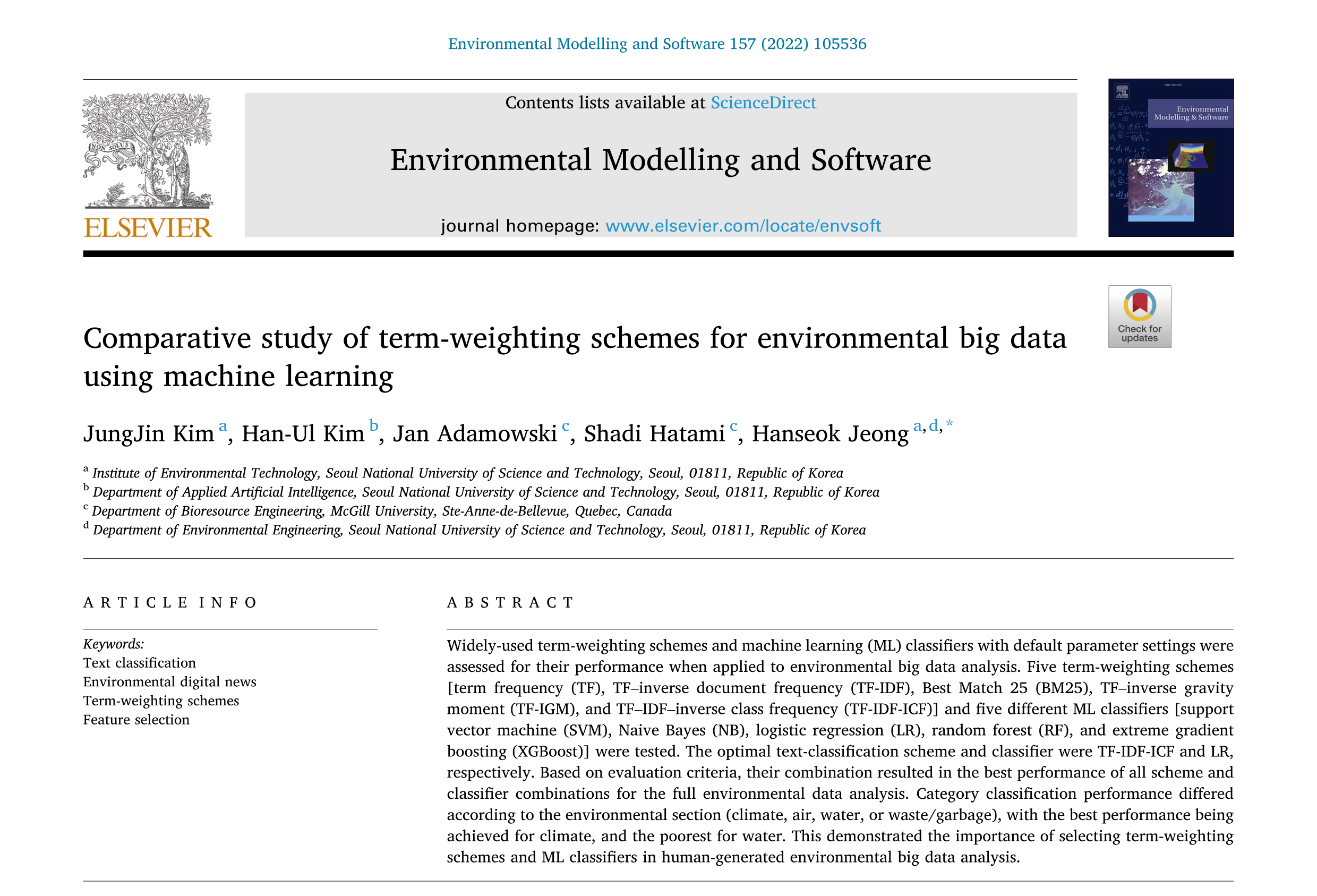
Paper published in Environmental Modelling & Software titled “Comparative Study of Term-Weighting Schemes for Environmental Big Data Using Machine Learning.” The study shows that choosing appropriate term-weighting schemes and machine-learning models is crucial for analyzing environmental big data. Congratulations and thanks to Dr. Jungjin Kim for leading this work.
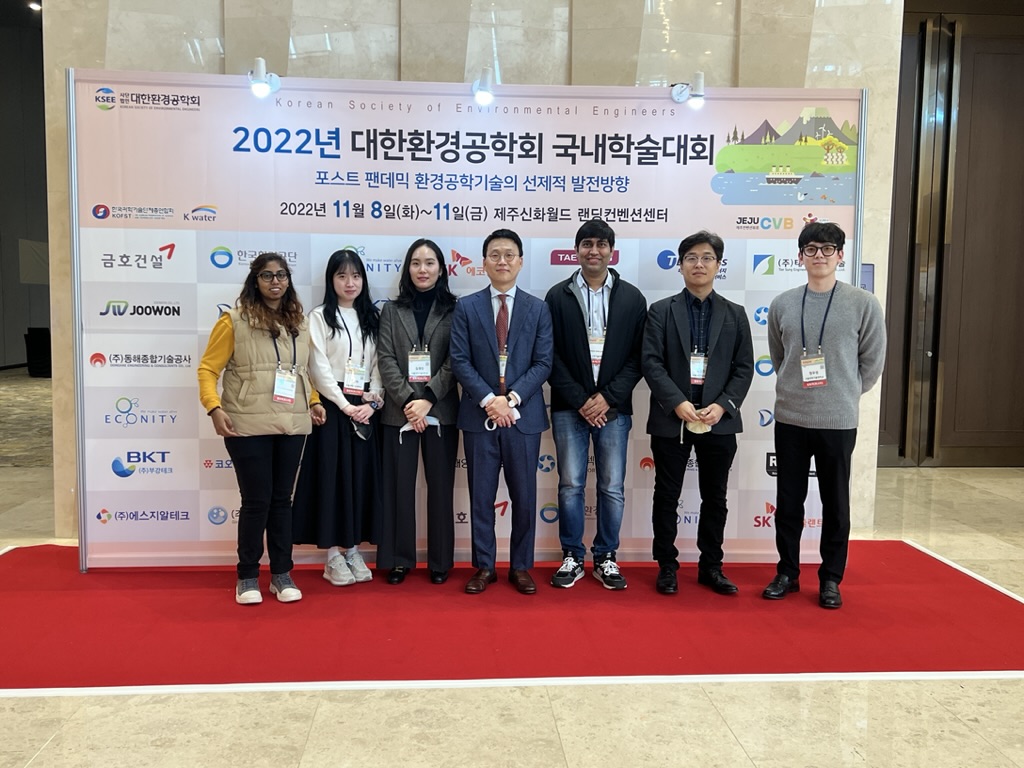
At the four-day KSEE conference held in Jeju, Dr. Kim presented “Environmental Big Data Center: Service Platform” and “Optimized Machine Learning Models for Environmental Text Classification.” Dr. Dubey presented “Trends Associated with the SPI and SPEI Indices Across Coastal and Inland Areas of South Korea.” Wuseong presented “Interpretation of Changes in Social Value on the Water Environment System From the Perspective of Transition Theory.” Kyungmin presented “River Microplastics Through the Lens of Water-Quality Parameters” and “Relationships Between Land Use and River Microplastics.” Akshita presented “Modeling Microplastic Behavior Using the WASP Toxicant Model.” Minah presented “A Watershed Evaluation Framework Based on the Socio-Hydrological Resilience Concept.”
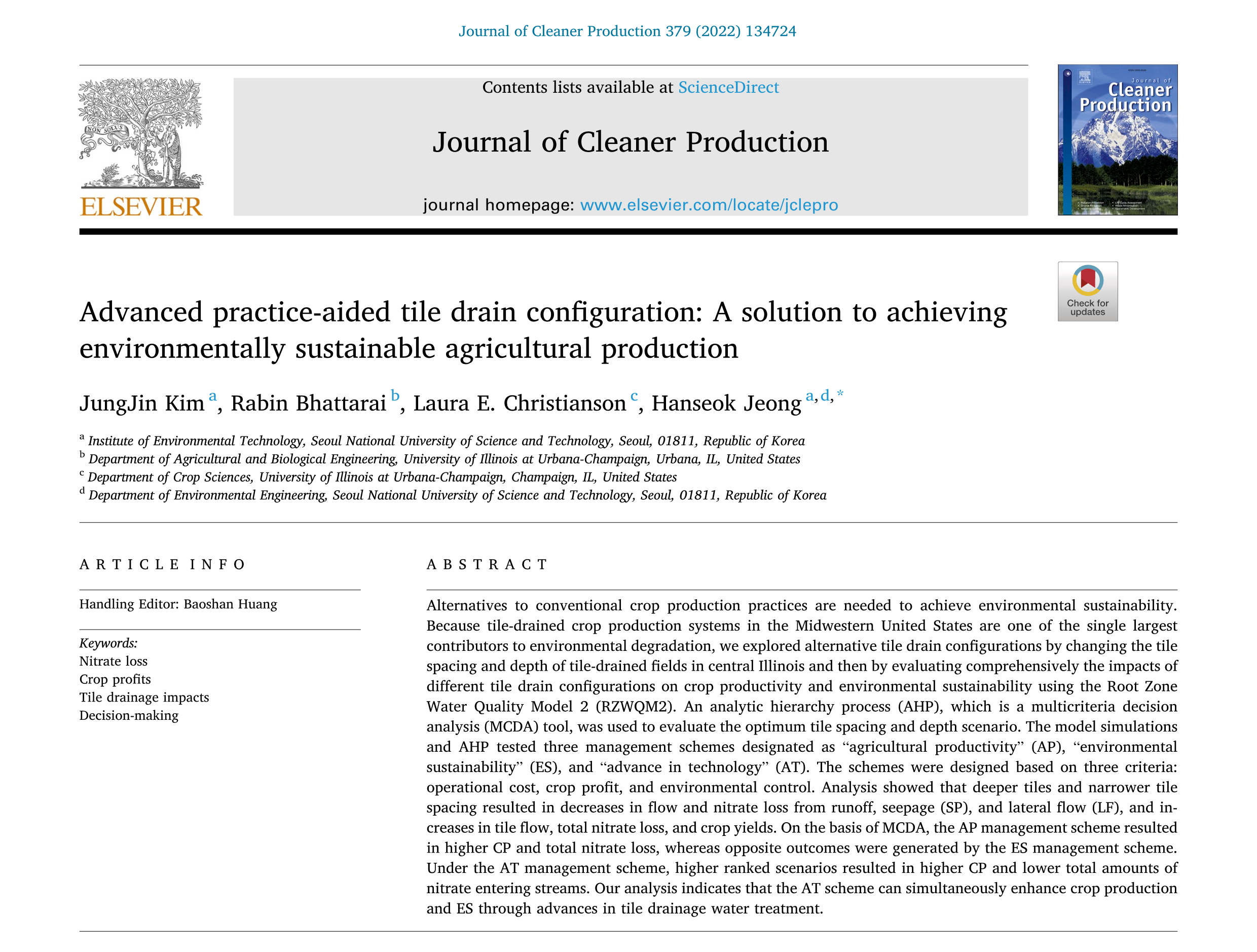
Paper published in Journal of Cleaner Production titled “Advanced Practice-Aided Tile Drain Configuration: A Solution to Achieving Environmentally Sustainable Agricultural Production.” The study shows that changing how subsurface tile drains are configured can strongly affect both crop yield and water pollution, and that combining improved tile designs with drainage-treatment technologies offers a promising path to enhance production while reducing environmental impacts. This collaborative research with Professors Bhattarai and Christianson at UIUC was led by Dr. Jungjin Kim. We sincerely thank and congratulate him for his efforts.
The paper titled “Information Extraction from Unstructured Data on Microplastics Through Text Mining”, based on one of Wuseong’s major M.S. research projects, was accepted for publication in the Journal of Korean Society of Environmental Engineers. Big congratulations to Wuseong on his first paper!
2021
Our lab was awarded the NRF Outstanding Young Researchers Grant for the project “A Use-Inspired Socio-Hydrological Framework for Integrated Water Resources Management in Agricultural Watersheds.” This four-year project (Mar 2021–Feb 2025), funded at 412 million KRW, aims to propose a new conceptual lens for agricultural-watershed hydrologic systems and to develop a socio-hydrological framework and model that can help design watershed management strategies responsive to water-environment policies and variability driven by climate change as well as agricultural and water-resource dynamics.
Wuseong and Kyungmin officially began their M.S. programs in our lab. Big welcome to both—wishing them a graduate journey full of good experiences, real growth, and plenty of research stories worth telling later.
At the conference held in Gwangju (one-night, two-day program starting June 3), Dr. Jungjin Kim presented “Comparison of Term-Weighting Schemes for Environmental Big Data Analysis,” Wuseong presented “A Historical Socio-Hydrological Study of the Water Environment of the Han River,” and Kyungmin presented “How Can We Better Understand Microplastic Pollution in River Environments?”
A collaborative study invited by Professor Taeil Jang, titled “APEX-Paddy Model Simulation of Hydrology, Total Nitrogen, and Rice Yield for Different Agricultural Activities in Paddy Fields,” was published in Paddy and Water Environment. We sincerely thank and congratulate Dong-Hyeon for leading the paper.
A collaborative paper titled “Paddy Rice Adaptation Strategies to Climate Change: Transplanting Date Shift and BMP Applications” was published in Agricultural Water Management, a leading journal in agronomy and water resources. The study evaluates how shifting transplanting dates and applying BMPs can serve as climate-adaptation strategies for agricultural systems. Many thanks and congratulations to Dong-Hyeon for leading this work.
Taekyung began a part-time Ph.D. program. The road can be tougher when you are doing it part-time—but we hope this becomes a fruitful doctoral journey. Big welcome, Taekyung!
At the first international sociohydrology conference (held online), Dr. Jeong presented “How Can Socio-Hydrology Underpin the Practices of Integrated Water Resources Management?”
Dr. Dubey joined our lab as a visiting assistant professor. Welcome, Dr. Dubey—we look forward to a vibrant period of collaboration and shared research momentum.
At the conference held in Jeju (two nights, three days), Dr. Jungjin Kim presented “A Comparative Study on Term-Weighting Schemes for Text Categorization of Environmental Big Data,” Wuseong presented “Changes in People’s Perception in the Water Environment Using Manual Coding,” Kyungmin presented “The Relationship Between Humans and River Microplastics,” and Hyungwon (undergraduate intern) presented “Intercomparison Between Machine Learning Algorithms for Water Quality Prediction.”
A collaborative study initiated during Dr. Jeong’s postdoctoral period in the United States was published in Water, led by Manas and Vaskar, under the title “Relative Contribution of Climate Change and Anthropogenic Activities to Streamflow Alterations in Illinois.” We extend our gratitude and congratulations to Manas and Vaskar for leading the paper.
2020
The News Archive page is under reconstruction — currently fueled by caffeine, determination, and the fact that our Google page suddenly refused to let us in.