Environmental Intelligence for Informed Decisions
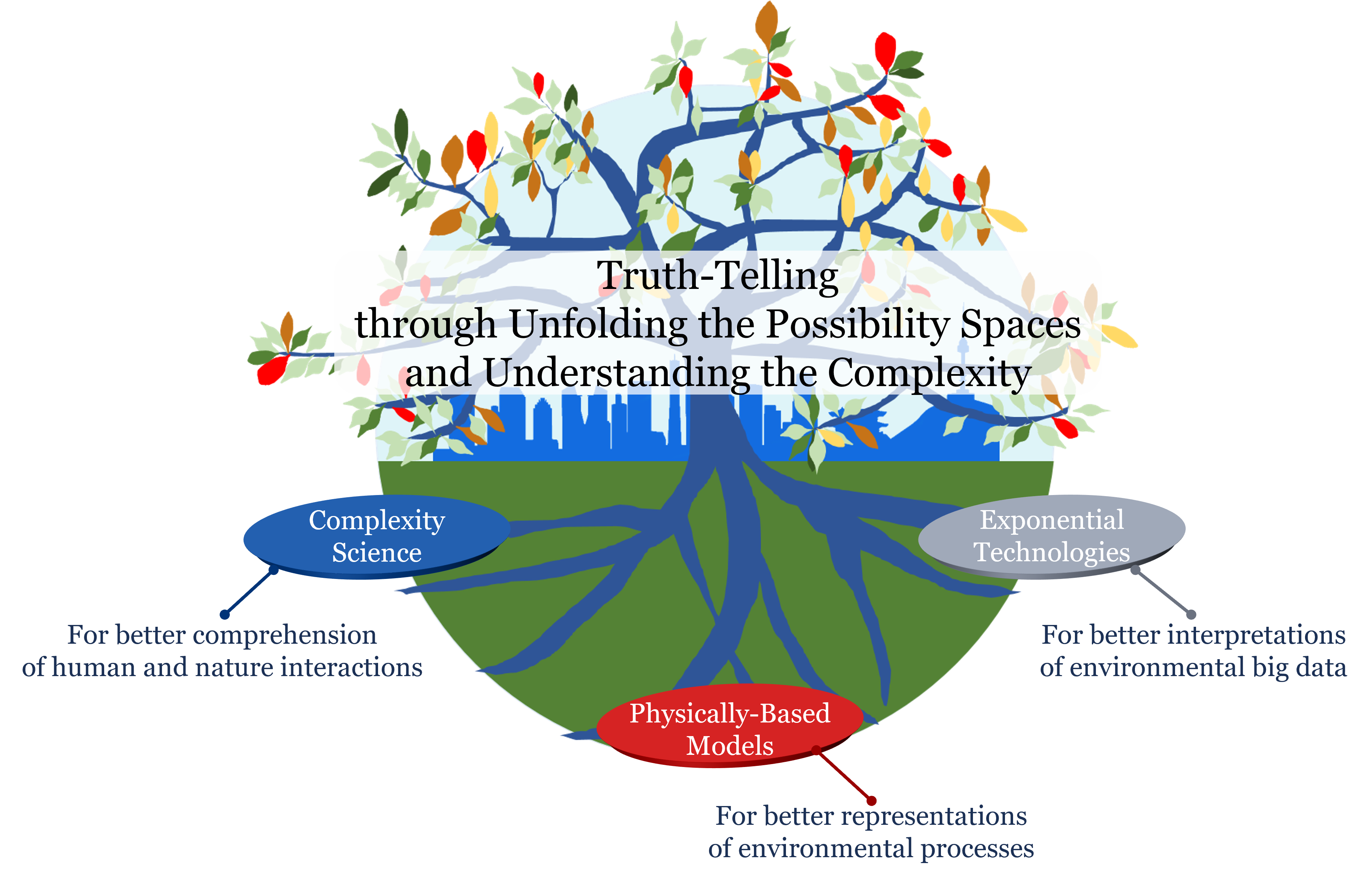
Our vision is Environmental Intelligence for Informed Decisions. Toward this vision, we pursue Truth-Telling through Unfolding the Possibility Spaces and Understanding the Complexity, grounded in three core pillars: Complexity Science, Physically-Based Models, and Exponential Technologies. Complexity science is for better comprehension of human–nature interactions, physically-based models for better representations of environmental processes, and exponential technologies for better interpretations of environmental big data.
Albert Einstein once remarked, “Environment is everything.” Our three pillars are not confined to the natural environment alone but also include us—human beings—recognizing that humans and nature are inseparable in addressing today’s global challenges confronting our communities.
Environmental Intelligence
Our concept of Environmental Intelligence refers to an integrative intelligent system that supports informed decisions toward a world where humans and nature are harmonized. It originates from the recognition of environmental systems as complex systems and operates through the fusion of physically-based models that represent natural processes with exponential technologies, including artificial intelligence, that emulate human behaviors and societal outcomes. Beyond the mere collection or provision of information, Environmental Intelligence embodies a cognitive system that senses environmental changes, interprets their meanings, and transforms insights into action—an organized endeavor of humanity to confront global environmental crises with the best of our knowledge and wisdom to sustain the long-term harmony between people and the planet.
2025 News
Our lab was awarded the NRF Mid-Career Research Grant for the project “Development of a SOHO-Based Hydrological Modeling Framework Enabled by Human Social Sensing for Navigating Agricultural Social-Hydrological Systems and Contributing to HELPING.” This five-year project (Mar 2025–Feb 2030) is funded at 1.35 billion KRW and aims to reinterpret hydrological modeling through the SOHO (Self-Organizing, Holarchic, Open Systems) framework. The project involves international collaboration with the University of Florida and Purdue University.
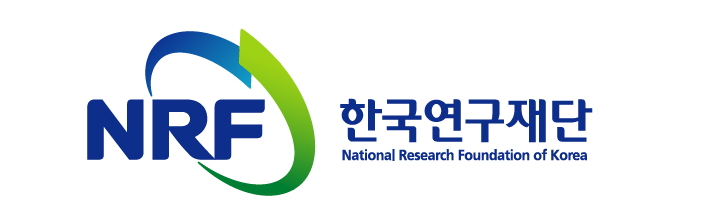
The lab held a one-night, two-day winter retreat at Vivaldi Park in Hongcheon, spending meaningful time reflecting on the past year and sharing plans for the future.
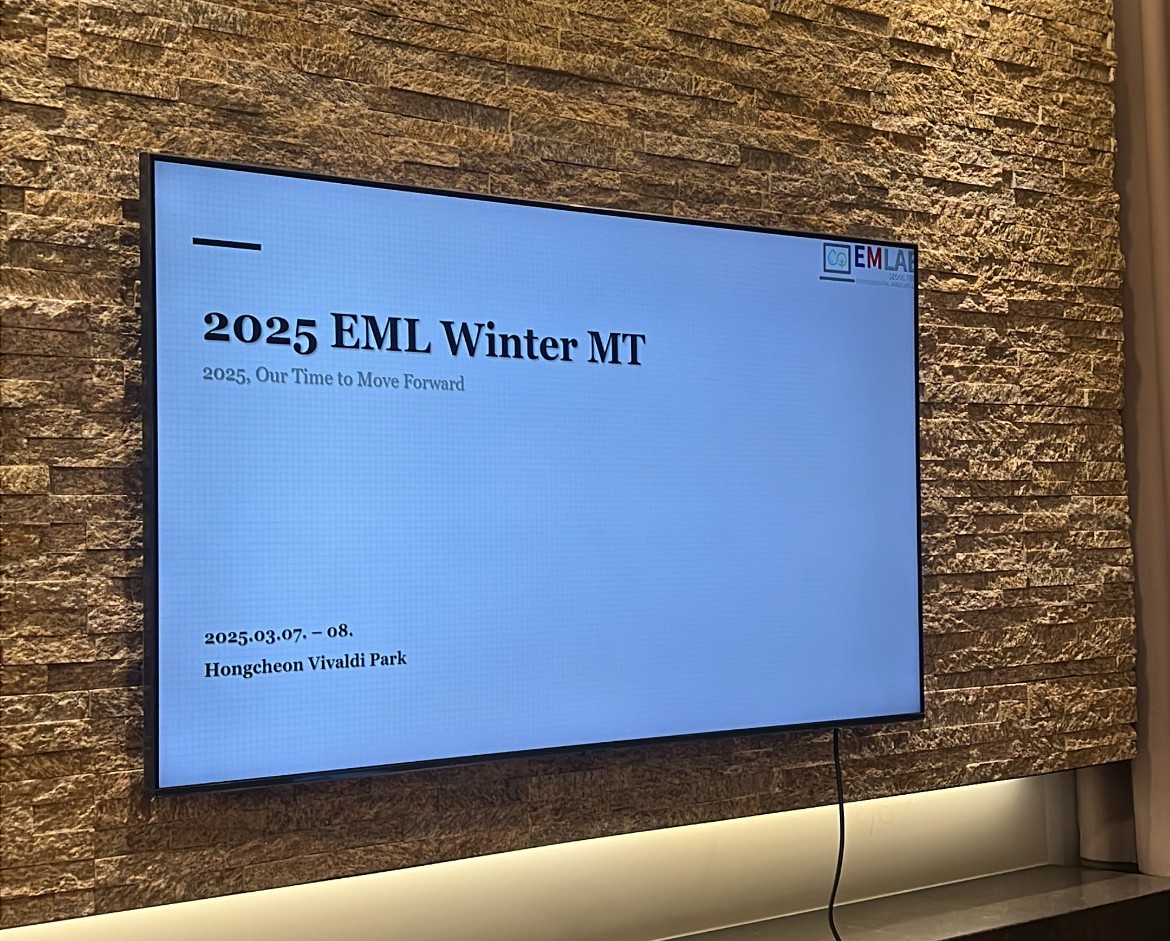
Our paper, "A Systematic Study of Hyperparameter Tuning for Environmental Text Classification: Implications for Environmental Management,” was accepted in the Journal of Environmental Informatics, a leading journal in the field of environmental information science. This study investigates the effectiveness of hyperparameter tuning in key machine-learning algorithms for processing environmental big data. Congratulations to Dr. Kim, the lead author!
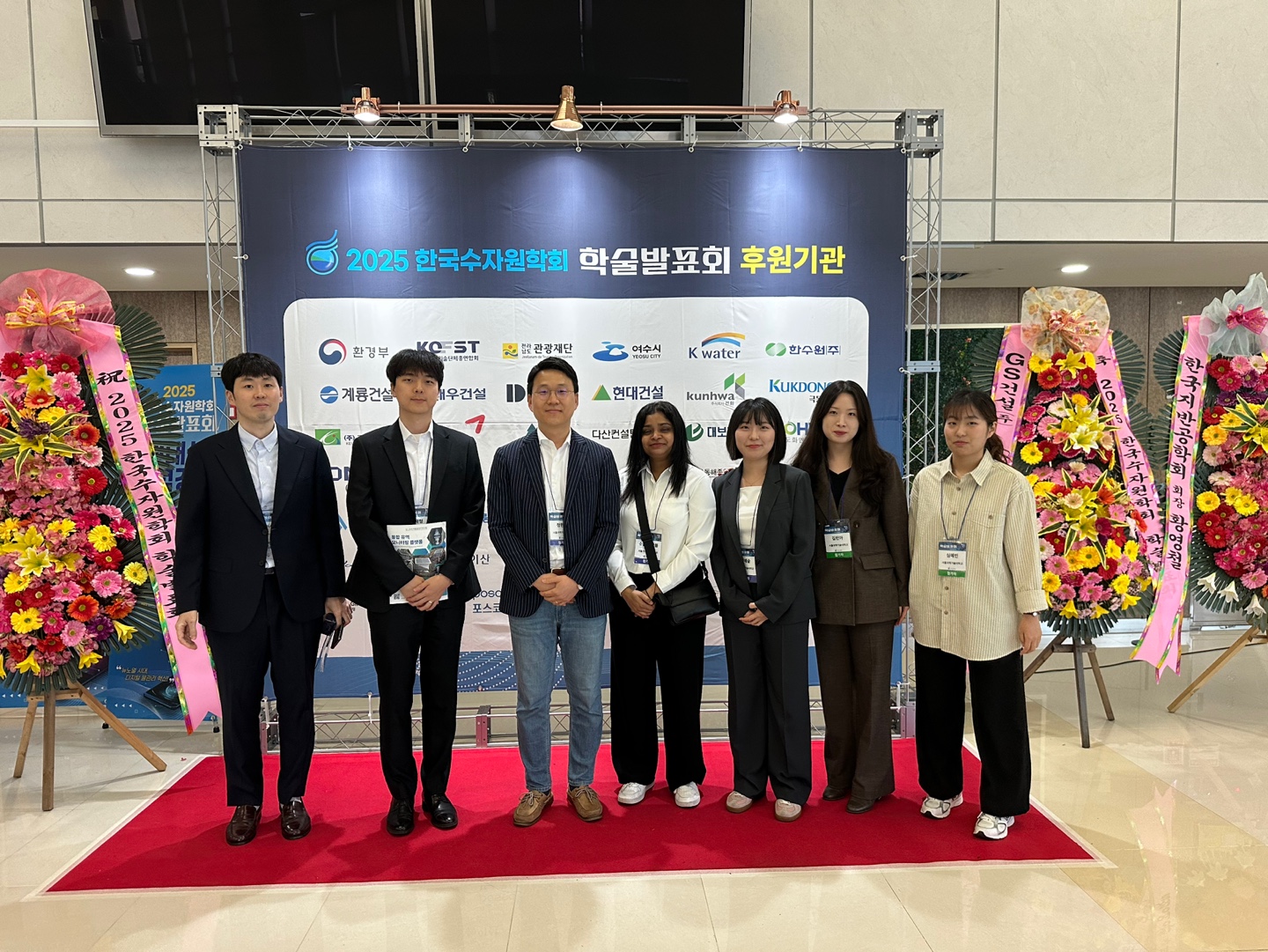
The lab attended the 2025 Spring Conference of the Korea Water Resources Association (KWRA) held in Yeosu. Juseong presented “Complementary Roles of Text Mining and Manual Coding,” Sonali presented “A Use-Inspired Sociohydrology Framework,” Minah presented “Impacts of Tile Drainage on Hydrological Systems,” Jaehyeong presented “Multi-Standard Load Duration Curves,” and Yeseul presented “Social Perception of Drought.” Jaehyeong received an Outstanding Presentation Award—congratulations!
Dahoon successfully completed his M.S. thesis defense titled “Modeling the Water Quality Improvement Effects of Best Management Practices for the Reduction of Combined Sewer Overflows.” After about three years of dedicated work, he delivered an excellent defense. Big congratulations to Dahoon for his hard-earned achievement!
The lab participated in the Expert Symposium of the Korean Society of Environmental Engineers (KSEE), held at KAIST in Daejeon from June 26–27, with Juseong and Sonali attending alongside Dr. Jeong.
Taking advantage of the advisor’s sabbatical year in the United States, the lab spent a 1-night, 2-day retreat in Gapyeong, where everyone was far too busy having fun to even remember taking photos. It turned out to be one of the most memorable retreats in our group’s history.
After serving as an undergraduate research intern at our lab and a research assistant at the Institute of Environmental Technology, Yeseul started her M.S. program. Welcome, Yeseul!
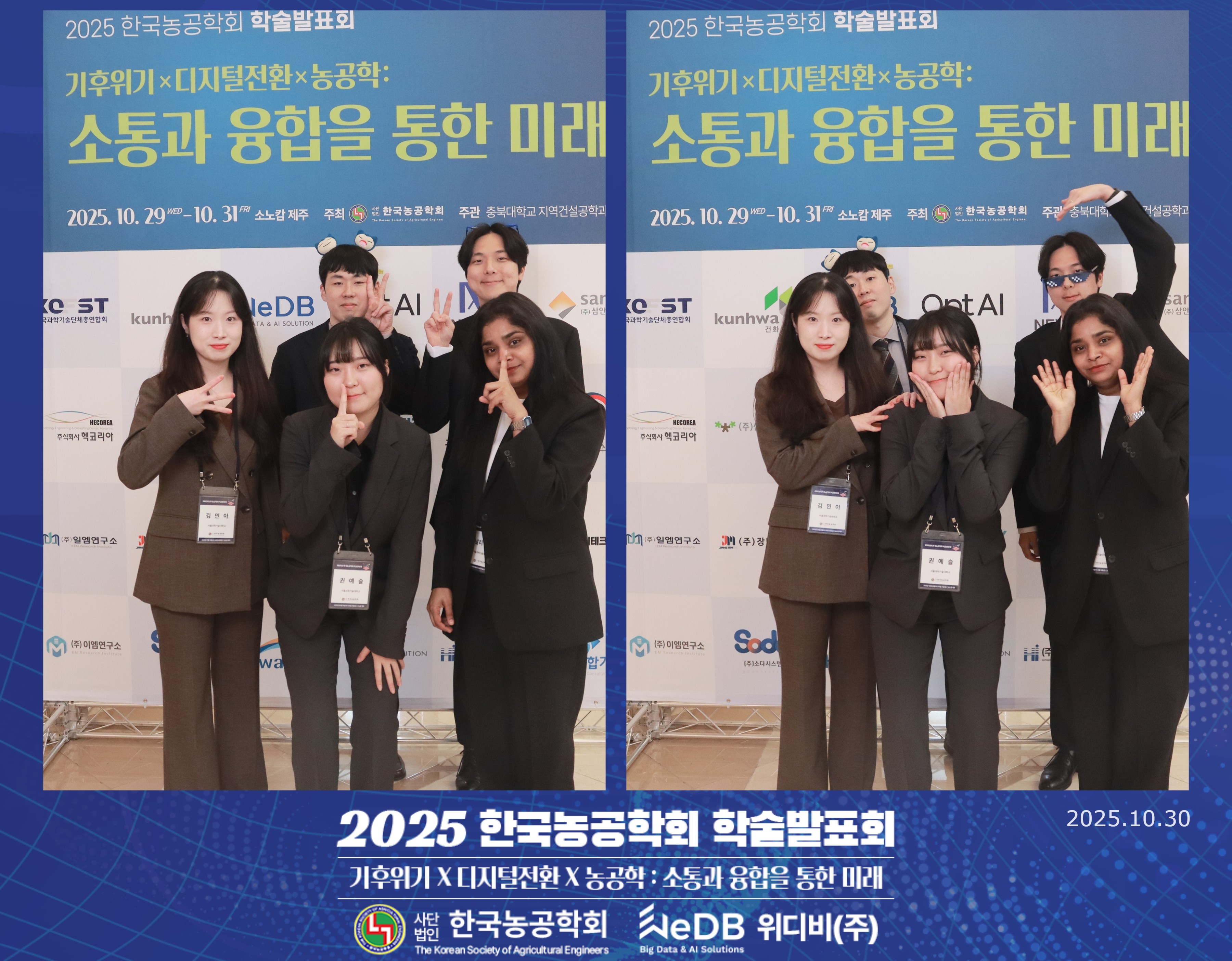
The lab attended the 2025 Fall Conference of the Korean Society of Agricultural Engineers (KSAE), held in Jeju. Juseong presented “Optimizing Farmland Subsurface Drainage Design,” Sonali presented “A Modular Sociohydrology Framework,” Minah presented “Hydrological Impacts of Nitrogen Fertilization Timing,” Jaehyeong presented “Agricultural Drainage Systems and Collective Action,” and Yeseul presented “Meteorological Drought Indices at Multiple Time Scales.” Sonali and Minah both received Outstanding Presentation Awards—congratulations!
The study previously awarded at the KWRA Spring Conference was accepted for publication in the Journal of Korea Water Resources Association, a Scopus-indexed journal. Supported by the National Institute of Environmental Research, this work proposes a new application of load duration curves for evaluating pollutant-load management performance. Congratulations to Jaehyeong on his first paper as lead author!
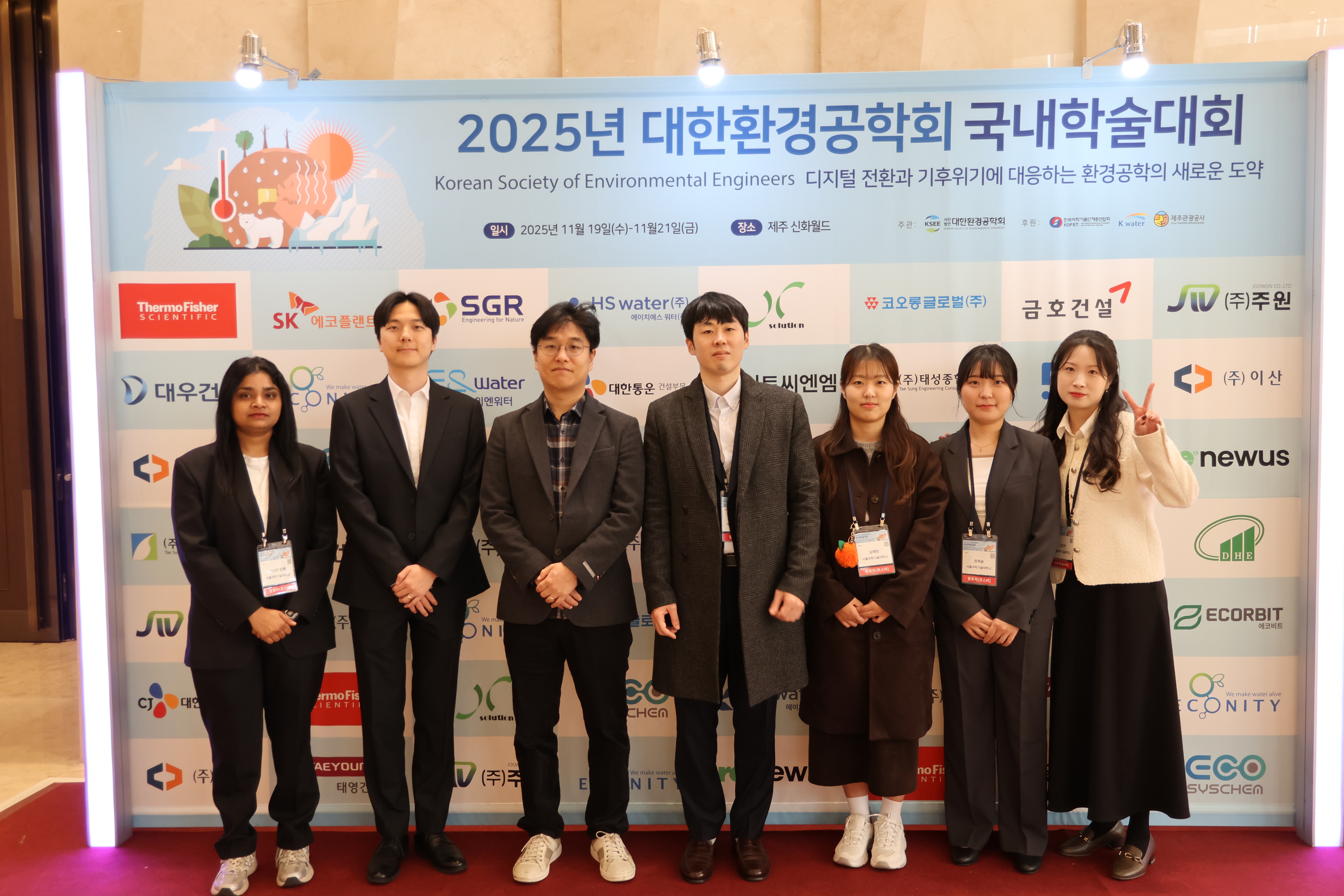
The lab attended the 2025 Korean Society of Environmental Engineers (KSEE) Fall Conference in Jeju for a 3-day program filled with presentations and, true to the spirit of an academic “symposium–conference,” even shared drinks with Prof. Oh’s group. Dr. Jungjin Kim presented “Development of a Deep Learning-Based Model for Estimating Streamflow and Pollutant Loads in Ungauged Basins,” Juseong presented “An Integrated Manual Coding–Text Mining Approach for Unstructured Big Data Analysis in the Water Environment,” Sonali presented “Strengthening Hydrology and Institution Subsystems in a General Sociohydrological Model,” Minah presented “Hydrological Impacts of Nitrogen Fertilization in a Tile-Drained Watershed under Climate Change,” Jaehyeong presented “Exploring the Effects of Climate Change on the Interactions Between Collective Action and Agricultural Drainage Systems,” Yeseul presented “A Review of Studies Toward Developing an Integrated Water Environment Assessment Framework under Compound Events,” and Yebin presented “Threshold of Impervious Area Ratio for Urban Flooding: A Case Study of the Gangnam Area Using SWMM.” Since their advisor is on his sabbatical, the group had to take a photo without him—resulting in a wonderfully gloomy-looking team photo that somehow hides the fact that everyone was actually delighted.
Contact
Email: hanjeong@seoultech.ac.kr
Phone: +82-2-970-6630
Office: Room 312, Chungun-Hall, SeoulTech
Lab: Room 120, Chungun-Hall, SeoulTech